All Stories

  1. How do CLIL practices relate to curricular requirements in Europe? Contributions for conceptualising bi- and multilingual disciplinary literacies
  2. Genre and Cognitive Discourse Functions as lenses on disciplinary language in CLIL contexts
  3. Navigating disciplinary literacies in search of beacons and shipping routes
  4. Pre-task planning in CLIL classrooms
  5. Living the multilingual university: the University of Prizren as a site of intercommunity contact in Kosovo
  6. Producing cognitive discourse functions in disciplinary Basque writing: developmental patterns across secondary education and L1 profiles
  7. The effect of collaboration on the adolescent EFL learners’ writing performance
  8. Review of Lasagabaster (2022): English-Medium Instruction in Higher Education
  9. L2 proficiency and development in CLIL
  10. CLIL in the 21st Century
  11. Learner repair during task-based peer interactions in an EMI classroom: a case study of a marketing class in a Chinese higher education setting
  12. CLIL for all? An exploratory study of reported pedagogical practices in Austrian secondary schools
  13. Cognitive discourse functions in CLIL classrooms: eliciting and analysing students’ oral categorizations in science and history
  14. Cognitive Discourse Functions meet historical competences
  15. Cognitive discourse functions in Austrian CLIL lessons: towards an empirical validation of the CDF Construct
  16. Postscriptum: research pathways in CLIL/Immersion instructional practices and teacher development
  17. Introduction to part III
  18. "You Can Stand Under My Umbrella": Immersion, CLIL and Bilingual Education. A Response to Cenoz, Genesee & Gorter (2013)
  19. Content and language integrated learning
  20. Content and Language Integrated Learning: A research agenda
  21. The power of beliefs: lay theories and their influence on the implementation of CLIL programmes
  22. CLIL classroom discourse
  23. A postscript on institutional motivations, research concerns and professional implications
  24. Content-and-Language Integrated Learning: From Practice to Principles?
  25. Research on language teaching and learning in Austria (2004–2009)
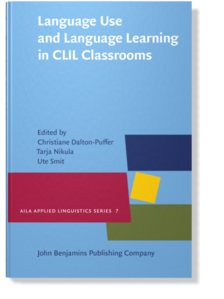
  26. Language Use and Language Learning in CLIL Classrooms
  27. ‘CLIL and Immersion Classrooms: Applied Linguistic Perspectives’
  28. The CLIL differential
  29. Language use and language learning in CLIL
  30. Charting policies, premises and research on content and language integrated learning
  31. Discourse in Content and Language Integrated Learning (CLIL) Classrooms
  32. Pragmatics of Content-based Instruction: Teacher and Student Directives in Finnish and Austrian Classrooms
  33. Words: Structure, Meaning, Function
  34. Morphological productivity across speech and writing
  35. Learner Attitudes and L2 Pronunciation in Austria
  36. Bertil Sundby. English word-formation as described by English grammarians 1600-1800
  37. The French Influence on Middle English Morphology
  38. Productive or Non-productive? The Romance element in Middle English derivation
  39. Are Shakespeare’s agent nouns different from Chaucer’s? – On the dynamics of a derivational sub-system
  40. Middle English is a creole and its opposite: On the value of plausible speculation