Interview
The Conversation - Our equation proves climate change is linked to emissions
An article published by The Conversation on how carbon emissions are directly linked to the surface warming of our planet.
University of Liverpool Faculty of Science and Engineering
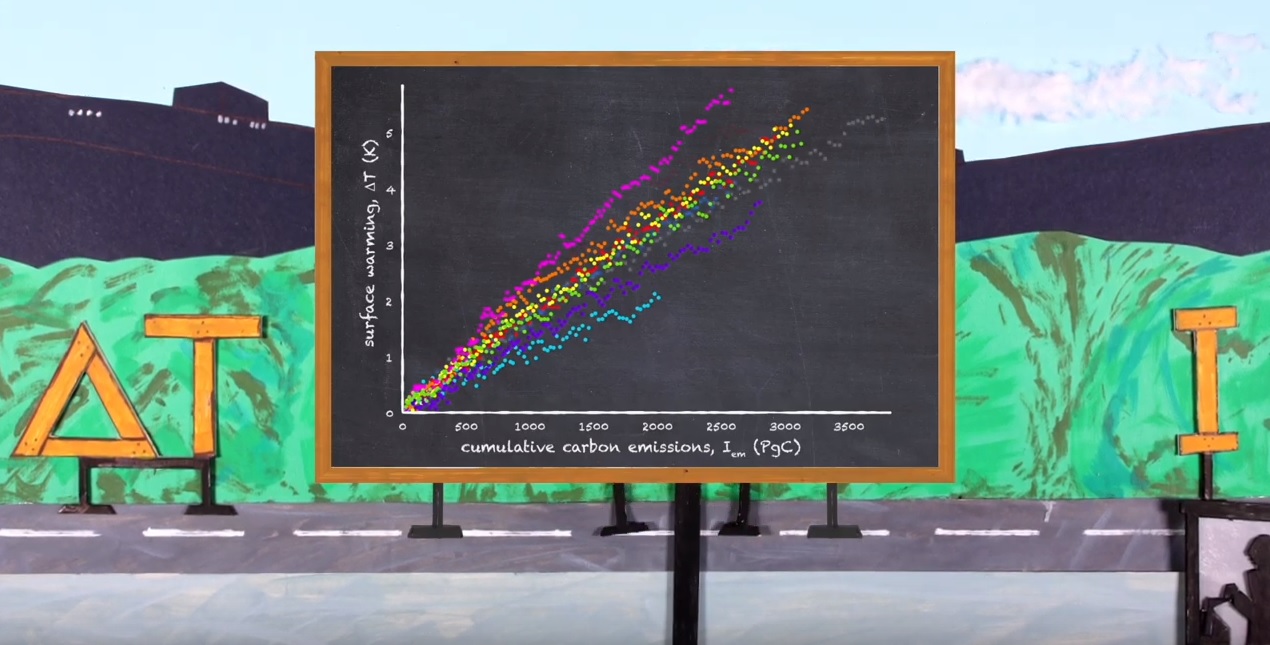
Climate models are used by environmental scientists to predict how much the surface temperature of the Earth is likely to rise over the next century for a given amount of carbon emitted into the atmosphere. Projections from these climate models reveal that global surface warming is almost proportional to cumulative carbon emissions on multi-decadal to centennial timescales. Climate models clearly agree on a simple result – the more carbon we emit, the warmer it will become. However, what is less clear is the cause of this relationship, the relative importance of different climate processes, and the amount the surface temperature of the earth will increase by for a given carbon emission.
In order to connect global surface warming with carbon emissions, a team of researchers at the Universities of Liverpool and Southampton developed and presented a single equation based upon a heat balance and a global carbon budget. They found that this near linear dependence between surface warming and carbon emissions is due to partially opposing effects from climate feedbacks, heat and carbon uptake. To gain further insight, the team focussed on the dependence of surface warming on carbon emissions. They found that this dependence is defined by the product of three terms: the dependence of surface warming on radiative forcing, the radiative forcing divided by the radiative forcing from atmospheric carbon dioxide, and the dependence of radiative forcing from atmospheric carbon dioxide on cumulative carbon emissions.
The researchers collaborated with academics at University of California, San Diego and Laboratoire des Sciences du Climat et de l'Environnement in France to further investigate the sensitivity of global surface warming to carbon emissions in a suite of nine Earth system climate models. In this study, the team diagnosed the response of these models to increasing atmospheric carbon dioxide over the rest of the 21st century. The researchers employed their theory to understand the different responses of each Earth system model. In addition, they assessed the global surface warming from carbon emissions in a suite of the latest Earth system climate models. The researchers were able to explain the inter-model spread in surface warming responses in the latest climate models, including nine CMIP6 and seven CMIP5 models.
Further work by researchers at Liverpool and Southampton investigated the climate warming response after carbon emissions cease. A coupled carbon-climate Earth system model was integrated for 1,000 years with emissions of carbon occurring for the first 98 years. Their study found that surface temperature rapidly rose while carbon emissions occurred, but then continued to rise for many centuries after the carbon emissions ceased. At first sight this continued warming after emissions cease might seem surprising. The researchers were able explain this response using their theory, connecting both surface warming and ocean heat and carbon uptake to carbon emissions. Their study found that after emissions cease, surface temperature evolves according to how much of the emitted carbon remains in the atmosphere and how much of the additional radiative forcing warms the surface rather than the ocean interior. Surface temperature continues to increase after carbon emissions cease through a decline in ocean heat uptake, which increases the proportion of radiative forcing warming the surface. Eventually, after many centuries, surface temperature declines as the excess atmospheric carbon dioxide is taken up by the ocean and land.
Projections from climate models differ in how much surface warming occurs for a given carbon emission. The theory developed through this body of research can be used to diagnose the global warming response in different climate models and mechanistically understand the differences between their projections.
Complex Earth system models are used to provide projections of how the climate will change with carbon emissions. However, it is difficult to understand the underlying cause of a climate model projections. A combination of theory and a new framework are used to interpret the climate response over the next century for nine complex Earth system models, based on an atmosphere–ocean general circulation model, including radiative forcing from a range of greenhouse gases and aerosols, and including a land carbon cycle.
This research found that inter-model differences in how much the surface warming varies with a carbon emission are mainly due to inter-model differences in the climate sensitivity, particularly linked to clouds, and how the climate model takes up heat and carbon. The ocean turns out to provide partially-opposing contributions: the ocean uptake of carbon acts to reduce the radiative forcing for a given carbon emission, while a relative decline in the ocean uptake of heat enhances the fraction of radiative forcing used to warm the surface.
For climate model integrations forced only by carbon emissions, this research found that the surface warming response to carbon emissions in the latest suite of climate models are particularly sensitive to the representation of clouds. Put simply, enhancing the amount of high cloud provides a climate feedback that acts to enhance surface warming (by absorbing and re-emitting infrared radiation), while enhancing the amount of low cloud overall acts to reduce surface warming (by reflecting more solar radiation). Inter-model differences in the cloud responses are now the major cause of the inter-model spread in surface warming responses to carbon emissions.
To avoid exceeding the 1.5°C warming target set out by the Paris Climate Agreement, we need to reduce the amount of carbon we emit into our atmosphere. However, this research shows that there may be continued warming for several centuries after carbon emissions cease, further emphasising the need for urgent action and systematic change.
We hope that this body of research provides a theoretical underpinning to understand the response of climate models. These studies brought together authors with different skills and resources to develop theory and frameworks that have been tested using a suite of climate models. While the detailed projections of climate models are sensitive to different model choices and forcing, the overall response is easy to understand – the more carbon we emit, the warmer our planet will become.

University of Liverpool Department of Earth Ocean and Ecological Sciences
An article published by The Conversation on how carbon emissions are directly linked to the surface warming of our planet.
AZoCleantech spoke to Professor Ric Williams about how oceans are moderators of our changing climate and how we can reduce our carbon emissions.
Discover how the University of Liverpool is responding to the global climate crisis through research into science, society and solutions.