Publication
Free snapshot of the report's findings and recommendations
Plus information about how to license the full report
Kudos Research

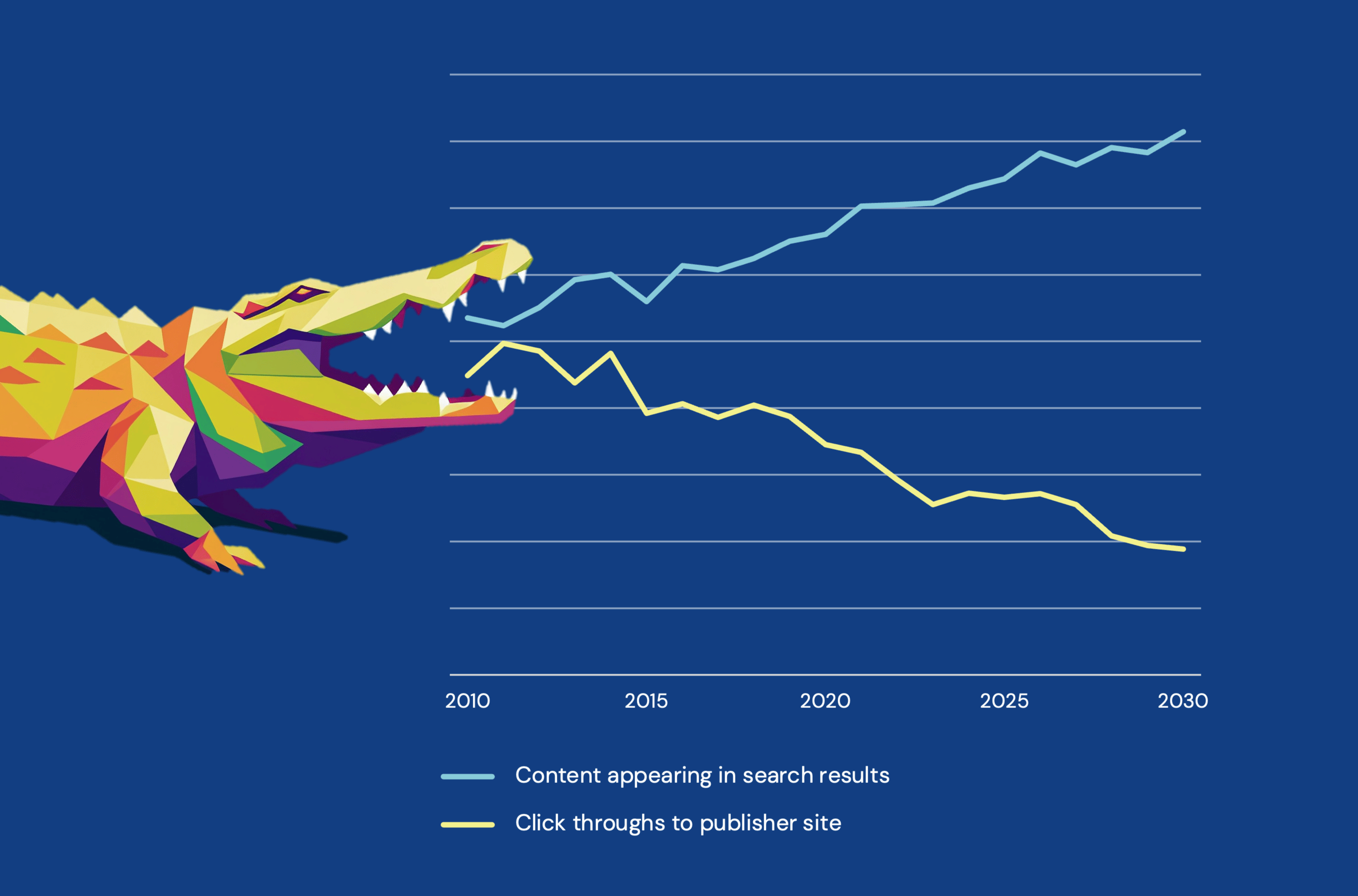
The Crocodile Effect is a rapidly growing threat to the reach and readership of scholarly and scientific content. It is the term used to describe the gap between impressions of content in search engines, and click throughs to the primary source for that content. This issue, also called “zero-click search”, has grown hugely since the growth of AI Overview panels in general search engines, and the whirlwind adoption of gen AI – between them, these two forms of AI-mediated discovery have become the starting point for over a third of information seeking journeys, and reduced usage of content by up to 70%.
“Taming the Crocodile” launched in late 2025 to collaborate in exploring and addressing this challenge. Phase I has been sponsored by 18 organizations including major publishers, societies and platform / service providers. It set out to understand how AI is changing the discovery of, and engagement with, scholarly content – and what that means for publishers and platforms. It comprised 2 surveys (users’ and librarians’ awareness / understanding / expectations of AI in information discovery) and an environment scan (over 300 sources + 10 events) to identify quick wins and medium / longer-term actions.
AI discovery threatens not only usage, but also research integrity and transparency. It takes content out of context (divorcing it from quality indicators and trust signals), and amplifies / camouflages misinformation (treating non-authoritative user-generated content the same as peer-reviewed content). This project provides 60+ recommendations for publishers, life sciences companies and communications agencies.
"I think this might be the most important piece of research I've delivered in my 25+ years in scholarly communication. Scholarly publishers and platforms are at an existential moment in terms of whether they can leverage AI discovery, or be superseded by it. Through this piece of work I have set out the pathway to how publishers can become more visible and strengthen their business via AI. It's exciting to be at the heart of this once-in-a-generation shift."

Kudos Innovations Ltd
Plus information about how to license the full report