All Stories

  1. How to ask (im)politely
  2. Frames for politeness
  3. Καλημέρα, kalimera or kalhmera?
  4. Different scalar terms are affected by face differently
  5. Coming to Grips With Variation in Sociocultural Interpretations: Methodological Considerations
  6. Uncivil Twitter
  7. Tracking opinion convergence online
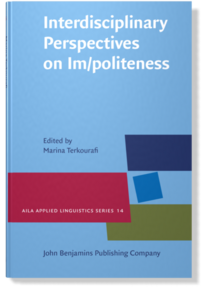
  8. Interdisciplinary Perspectives on Im/politeness
  9. First-order politeness in rapprochement and distancing cultures
  10. The importance of being indirect
  11. The Role of the Speaker’s Emotional State in Im/politeness Assessments
  12. What, When and How? Spanish Native and Nonnative Uses of Politeness
  13. Disentangling Politeness Theory and the Strategic Speaker approach: Theoretical considerations and empirical predictions
  14. Familiarity and disappointment: A culture-specific dimension of emotional experience in Greece?1
  15. Triangulating the GRID: A corpus-based cognitive linguistic analysis of five Greek emotion terms1
  16. JonathanCulpeper (ed.). Historical Sociopragmatics (Benjamins Current Topics 31). Amsterdam, The Netherlands: John Benjamins. 2011. vii + 135 pp. Hb (9789027202505) €80.00/$120.00 / Eb (9789027286604) €80.00/$120.00.
  17. Re-Assessing the Speech Act Schema: Twenty-First Century Reflections
  18. Chapter 10. Between pragmatics and sociolinguistics
  19. Why direct speech is not a natural default: Rejoinder to Steven Pinker's “Indirect Speech, Politeness, Deniability, and Relationship Negotiation”
  20. The puzzle of indirect speech
  21. The pragmatic variable: Toward a procedural interpretation
  22. From Politeness1 to Politeness2: Tracking norms of im/politeness across time and space
  23. Thank you, Sorry and Please in Cypriot Greek: What happens to politeness markers when they are borrowed across languages?
  24. Don’t go V-ing in Cypriot Greek
  25. Introducing Greek Conversation Analysis
  26. What-is-Said From Different Points of View
  27. Conventionalized speech act formulae
  28. 8. A critical look at the desktop metaphor 30 years on
  29. 2: What Use Is ‘What Is Said’?
  30. On the loss of the masculine genitive plural in Cypriot Greek
  31. On de-limiting context
  32. Constructions of Intersubjectivity: Discourse, Syntax, and Cognition
  33. Speaking of pain in Greek: Implications for the cognitive permeation of emotions
  34. Perceptions of difference in the Greek sphereThe case of Cyprus
  35. Politeness
  36. Understanding the present through the past
  37. Beyond the micro-level in politeness research
  38. Identity and semantic change
  39. An argument for a frame-based approach to politeness
  40. ARIN BAYRAKTAROGLU and MARIA SIFIANOU (eds.), Linguistic politeness across boundaries: The case of Greek and Turkish. Pragmatics and Beyond New Series, 88. Amsterdam: John Benjamins, 2001. Pp. xiv, 439. Hb $125.
  41. Testing Brown and Levinsons theory in a corpus of spontaneous conversational data from Cypriot Greek
  42. Formulaic Language and the Lexicon
  43. The Semantics/Pragmatics Interface from Different Points of View
  44. Generalised and particularised implicatures of linguistic politeness
  45. Politeness and formulaicity: Evidence from Cypriot Greek
  46. Pragmatic correlates of frequency of use: The case for a notion of “minimal context”
  47. Politeness and pragmatics