
Publication
Symbiosis of nematodes, fungi and beetle vectors
i) whether the insect-dispersed nematodes feed on fungi inoculated by bark beetle? ii) whether some pathogenic fungi are vectored by nematodes?
Alexander Ryss
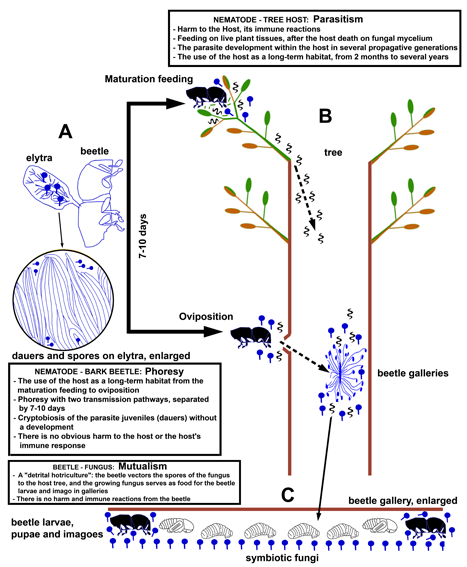
The concept of symbiosis includes cohabitation of two or more organisms of different taxa. Examples of tripartite symbiosis (TS) are known, but are considered to be unique manifestations of evolution (lichens, fungus-growing ants) and so far the concept of TS has not been applied to the vector-borne woody plant pathogens. Wilt of conifers and the dieback of deciduous trees are epidemic diseases of quarantine importance, causing significant economic damage world-wide. They are spread by an association of three pathogens. Beetle vectors are part of the pathogenic association, they spread simultaneously the phoretic stages of pathogenic fungi and nematodes. The interactions: ‘beetle-nematode’ and ‘beetlepathogenic fungus’ have been well studied in the model species. However, the relations between nematode and entomochore fungus have received insufficient attention. It is the generally accepted opinion, that after beetle infection of a healthy tree, the nematode and fungus independently cause the tree to die by destroying the water and nutrients conductive pathways, and in the dead tree, the nematode switches to feeding on the mycelium of the fungus, while the fungus feeds on the dead wood. Such views are supported by mycophagy of phytopathogenic nematodes, practically used in vitro for the wood-inhabiting nematode cultivation. However, it remains unknown whether in dead wood the pathogenic nematodes of the family Aphelenchoididae feed on their fungal entomochore partners, i.e. on phytopathogenic fungi inoculated by the same beetle, or whether nematodes feed on the non-vectored saprotrophic fungi during detrital succession.
Project is aimed to experimentally identify stable trophic relationships between phytopathogenic nematodes and fungi in a phoretic association on an invasive beetle vector.
Project tasks are: - to isolate and cultivate fungi persistently associated with vector beetles belonging to an invasive regional group; - to validate trophic preferences of the beetle-vectored phytopathogenic nematodes by a successful cultivation on fungi isolated from the same beetles; - to identify the entomochore fungal species trophically suitable for the propagation of phytopathogenic nematodes in vitro, thus revealing the harmful tripartite symbiosis “xylobiont nematode-fungus-beetle”. - to isolate and identify species of symbiotic nematochore fungi from the body surface of xylobiont entomochore nematodes themselves, trophically suitable for a propagation in vitro of these phytopathogenic nematodes (a hypothetical fungal horticulture).
At this stage of research my task is to restrict the range of really efficient and stable partners (nematodes-fungi-beetle) in the most common diseases of trees in Russia. It will be a combination of the field surveys and the laboratory in vitro tests aimed to detect the pathogens synergisms or antagonisms during experimental infection of tree cuttings
i) whether the insect-dispersed nematodes feed on fungi inoculated by bark beetle? ii) whether some pathogenic fungi are vectored by nematodes?
Fungi from vector beetles are capable of maintaining the population of elm nematode Bursaphelenchus ulmophilus (associated with Dutch elm disease) for 6 months
