

Publication
The Comparison of the IDA and ET on Steel Structures Rehabilitated by Isolators
DOI: 10.22075/jrce.2014.208
Hamed Arshadi
Endurance time (ET) method is a relatively new performance-based earthquake method for structural evaluation and design. In this method, the structure is subjected to a gradually intensifying accelorogram(s) and its performance is assessed based on the maximum time duration that it can meet the specified performance objectives. Using moment-resisting and braced frames which are rehabilitated by base isolators; it is shown that ET can estimate results of the Incremental dynamic analysis (IDA) with acceptable accuracy. Spectral acceleration has been considered as the intensity measure. While the IDA would require several nonlinear dynamic analyses under multiple suitably scaled ground motion records, the ET can practically estimate the seismic behavior of simple to complex systems only by few nonlinear time history analyses. Moreover, it is shown that even in intense ground motions, super structures do not show considerable nonlinear behaviors and interstory drifts, because of energy dissipating by base isolation. The results also show that the ET method has the benefits of both time history analysis and the simplicity of the nonlinear static methods and can potentially be a useful tool for evaluation and designing seismic-resistant structures.
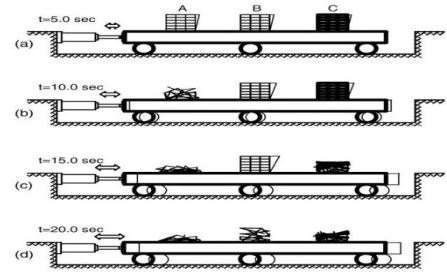
Due to recent advances in the field of earthquake engineering, More efficient seismic-resistant design and rehabilitation methods have been innovated, which facilitate the way towards construction of much safer structures. Performance-based earthquake engineering (PBEE) is a relatively novel approach, in which structural elements are designed based on achievement of a levy of performance objectives. Different performance objectives can make the structural rehabilitation or H.Arshadi et al./ Journal of Rehabilitation in Civil Engineering 2-2(2014) 46-6247design process more flexible, based on some factors like: frugal situation, importance and functions of structures, risks levels, and so on. This phenomenon is a conspicuous development in the domain of civil engineering, because it enables engineers to suggest more economical design and rehabilitation plans. Performance objectives relate performance levels (as an analysis output) and risk levels (as an analysis input) to each other. As for performance levels, they show levels of structural damage which can be displacements, rotation of hinges or drift ratios. To monitor and control lateral displacements of structures, an accurate estimation of maximum lateral displacement of structures subjected to various ground motions is called for. Structures under such ground motions may step into inelastic phase. But the evaluation of seismic performance of structures with nonlinear dynamic analysis has some complications out of haphazard characteristic of ground shakings and being very time-consuming. Accordingly codes recommend using other simple techniques, and by passing the time, new techniques have been being innovated to solve these mentioned problems.Incremental dynamic analysis (IDA) is a kind of time history analysis in which structures are exposed to records, each of which are scaled for different intensifying levels of excitations. Therefore at different intensity measures (IMs), engineering demand parameters (EDPs) are achieved. This method can give a complete description of structural behavior from the weakest to strongest ground motions. Accordingly this method is the most accurate and complete method, but it needs a huge number of nonlinear dynamic analyses-because the results change from record-to-record significantly. Moreover, the procedure of processing its results is complicated and time consuming. Then researchers try to solve these drawbacks by either decreasing the number of ground acceleration records or finding other equivalent methods like the endurance time method (ET).The endurance time method (ET) is a time-history-based analysis which has been introduced as a potential alternative to the incremental dynamic analysis and the nonlinear static analysis. The concept of ET is originated from the IDA method.[1]This method has accuracy of the IDA method and simplicity of the pushover procedure. In this method the EDPs of structures at different IMs are predicted by subjecting those structures to some predesigned intensifying records. IMs in ET acceleration functions are time, in other words the intensity of records increases with time constantly. Because of the intensifying essence of these records, they can provide a fair evaluation of the structures through elastic to yielding and nonlinear inelastic phases[2], (and finally global dynamic instability).
n this paper the accountability and applicability of the ET method in estimation of seismic performance of steel structures which are rehabilitated by base isolators are assessed in nonlinear seismic analyses by comparing their results with those of incremental dynamic analysis. Firstly, the concept of endurance time method and its methodology are discussed. Later, an existing steel structure is rehabilitated by base isolation and lastly, as will be demonstrated, EDPs calculated by the ET method are compared with those from incremental dynamic analysis. Ultimately, this comparison show fair consistency between results of these two methods.

Semnan University of Medical Sciences and Health Services
DOI: 10.22075/jrce.2014.208