Publication
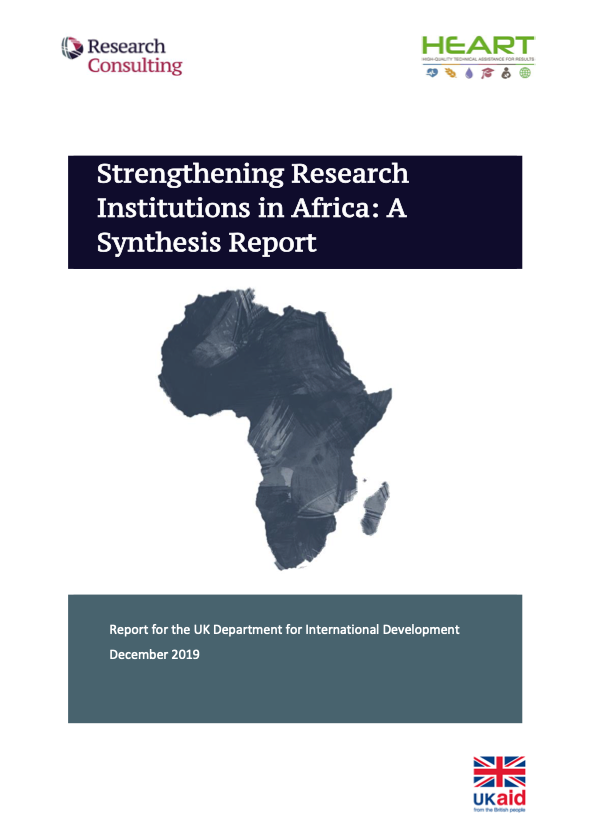
Strengthening Research Institutions in Africa: A Synthesis Report
This report summarises the key findings arising from the needs assessment of seven African countries that were considered for inclusion in DFID’s ‘Strengthening
Research Consulting
This page summarises the results of a one-year study of research system strengthening in low- and medium-income countries.
The study included two phases: • a rapid evidence assessment (REA) of research capacity strengthening interventions in LMICs • an analysis of the needs and strengths if the research system in seven African countries (Ethiopia, Ghana, Kenya, Nigeria, Rwanda, Tanzania, and Uganda).
This is the first study that tries to systematically assess research systems using a replicable methodology comprising of 104 qualitative and quantitative indicators. This research was conducted by Research Consulting for the UK Department for International development (DFID) to inform the Strengthening Research Institutions in Africa (SRIA) programme.
More information on SRIA can be found by visiting: • DevTracker (https://devtracker.dfid.gov.uk/projects/GB-GOV-1-300781) • R4D (https://www.gov.uk/dfid-research-outputs)
Research systems that enable researchers, funders, and users of research to work together productively are an important component of economic development. As well as producing research outputs and expertise that can guide economic, social and political development, research systems help to create a culture of critical, evidence-informed thinking. They help frame debates, shift social norms, increase participation and promote inclusion. Strong research systems increase human capital, underpin the transition to knowledge-based economies, and promote innovation.
When we started the project, we were surprised to see how little attention had been paid to research system strengthening. Historically, much of the focus had been on strengthening research capacity at the researcher or - at best - organisational level. This study begins to address the evidence gap by assessing research systems needs in selected LMICs. More importantly, it introduces a method that can be replicated across the developing world and refined over time to guide strategic interventions in this area.

Research Consulting Limited
This report summarises the key findings arising from the needs assessment of seven African countries that were considered for inclusion in DFID’s ‘Strengthening
International donors have long supported efforts to strengthen research capacity in LMICs as a means of achieving long-term sustainable development.
This needs assessment report is based on the analysis of 110 quantitative and qualitative research capacity indicators.
This needs assessment report is based on the analysis of 110 quantitative and qualitative research capacity indicators.
This needs assessment report is based on the analysis of 110 quantitative and qualitative research capacity indicators.
Poster summarising a study reviewing best practices in research capacity strengthening and assessing research needs in seven African countries: Ethiopia, Ghana,
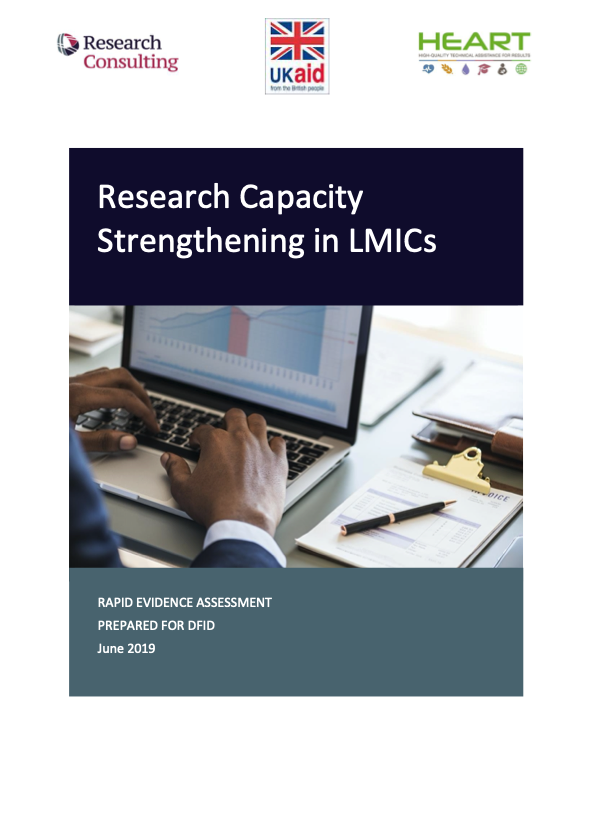
Poster summarising literature on research capacity strengthening in LMICs.
Poster summarising research environment indicators, as part of a comparative assessment of Ethiopia, Ghana, Kenya, Nigeria, Rwanda, Tanzania and Uganda.
Poster summarising research outputs indicators, as part of a comparative assessment of Ethiopia, Ghana, Kenya, Nigeria, Rwanda, Tanzania and Uganda.
Infographic summarising key research indicators in Ethiopia.
Infographic summarising key research indicators in Ghana.
Infographic summarising key research indicators in Kenya.
Infographic summarising key research indicators in Nigeria.
Infographic summarising key research indicators in Rwanda.
Infographic summarising key research indicators in Tanzania.
Infographic summarising key research indicators in Uganda.
Mapping of national and international stakeholders across the seven SRIA countries

Research Consulting Limited

Consort Strategy

Research Consulting Limited
Research Consulting Limited