Who is involved?
 Elena Gorokhova
Stockholm University
 Docent Dr. Rehab El-Shehawy
Stockholm University
- Elena Gorokhova
 (External link)
 (External link)
 (External link)
 (External link)
 (External link)
 (External link)
Elena Gorokhova
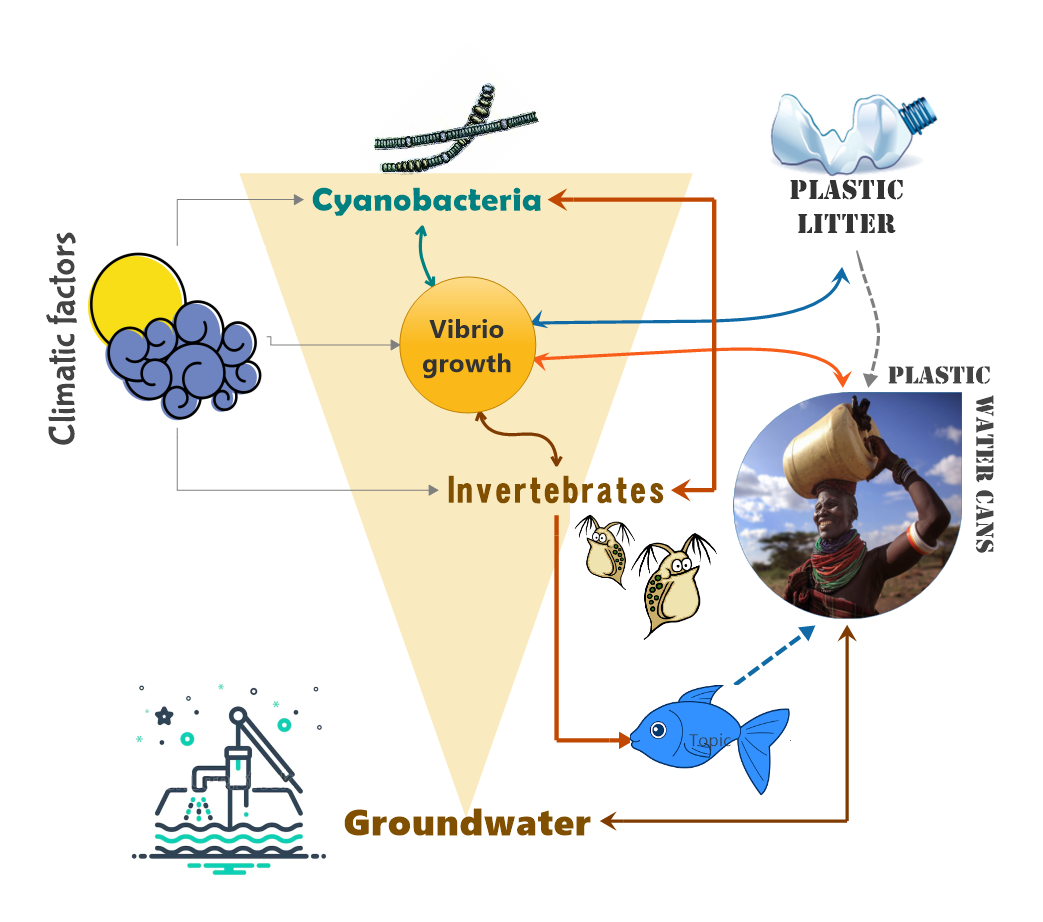
The aim is to develop a framework for the assessment of Vibrio ecological reservoirs and to apply this framework for predicting the diversity and load of Vibrio in ecosystems with regular cyanobacteria blooms. A team of ecologists, microbiologists, chemists, and hydrologists will explore the role of cyanobacteria-driven Vibrio propagation across the freshwater and brackish systems in the Baltic region and Africa. We will also link Vibrio communities in the surface waters to those in groundwater, and evaluate how plastic litter and water use behavior of humans may affect Vibrio persistence in countries with water scarcity. Our findings will contribute to capacity building for microbiological monitoring in developing countries and the development of ecosystem-based management of water resources in Africa.
Funded by Swedish Research Council (Vetenskapsrådet).
Partners: Sweden: Elena Gorokhova, Rehab El-Shehawy (Stockholm University); Egypt: Ranya Amer (SRTA-City); Spain: Anna Casaponsa (SME: Villaplana Casaponsa SL); Uganda: Godfrey Bwire (Makerere University); South Africa: Nelson Odume (Rhodes University), Harrison Pienaar (CSIR); Malawi: Emmanuel Vellemu (Malawi University of Science and Technology).
Climate change is implicated in the spread of vibriosis, a group of diseases caused by Vibrio bacteria. Due to rising temperatures, the climate suitability for Vibrio has increased worldwide, with ecosystem-wide impacts on humans and animals. However, in addition to the direct stimulation of Vibrio growth, the changing climate affects other ecosystem components, such as bloom-forming cyanobacteria, that provide habitat and mediate Vibrio persistence in the so-called ecological reservoirs. In such systems, the infiltration of vibrios to groundwater is more likely, and additional pressures, e.g., plastic pollution, accelerate the spread of these bacteria.
Over the past two decades, the world has faced several infectious disease outbreaks. Ebola, Influenza A (H1N1), SARS, MERS, Zika virus, and, most recently, COVID-19, had global impacts on economies, local and global public resources, and, above all, human health. To understand how a microorganism may grip us, we need to go far beyond human hospitals and into the wild, where they persist in natural communities. As ecologists and epidemiologists, we aim to understand the biocomplexity of pathogens in the environment, their interactions with hosts and co-habitants, the capacity of their environmental reservoirs, and vectors to humans. Understanding how environmental conditions predispose microbes to outbreaks helps to foresee these events, which is particularly challenging when the global change affects not only growth conditions for pathogens but also their ecological interactions.
Stockholm University
Stockholm University
Stockholm University
(External link) (External link) (External link) (External link) (External link) (External link)