Other
Extender Summary - Mechanism of Protective Actions of Sparsentan in Chronic Kidney Disease Models
Learn more about the mechanisms behind the protective actions and safety profile of sparsentan in chronic kidney diseases. Read now.
Travere Therapeutics
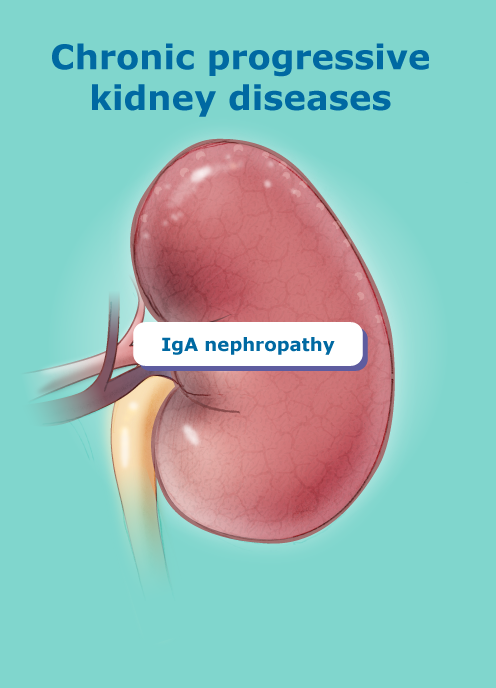
IgA nephropathy is a progressive chronic kidney disease (CKD).
Endothelin-1 (ET-1) and angiotensin II (Ang II) are important disease mediators in IgA nephropathy.
Both ET-1 and Ang II have similar pathophysiological roles and together they upregulate each other, exerting an additive effect. This drives ongoing kidney damage.
Sparsentan is a Dual Endothelin Angiotensin Receptor Antagonist (DEARA). It inhibits the binding of ET-1 and Ang II to the endothelin type A receptor (ETᴀR) and the angiotensin II subtype 1 receptor (AT₁R), respectively.
Blocking disease mediators, ET-1 and Ang II, may slow kidney function decline.
In IgA nephropathy ongoing kidney damage is driven by the upregulation of ET-1 and Ang II. This can lead to several damaging effects including proteinuria, glomerulosclerosis, and podocyte damage.
Blocking disease mediators, ET-1 and Ang II, may reduce glomerular injury and preserve kidney function.
Sparsentan hinders the binding of ET-1 and Ang II to ETᴀR and AT₁R, respectively–preventing upregulation of both.
Effects of sparsentan in IgA nephropathy include: - Anti-inflammatory* - Anti-proliferative* - Anti-fibrotic* - Anti-proteinuric
Preclinical data support the direct cellular, and resulting structural, actions of sparsentan.*
The effects of sparsentan may contribute to nephroprotection in IgA nephropathy.*
In clinical studies, sparsentan had a comparable safety profile to irbesartan.
*These effects are based on preclinical animal modeling data.
MA-SP-24-0125 | February 2026
Learn more about the mechanisms behind the protective actions and safety profile of sparsentan in chronic kidney diseases. Read now.
