These additional findings from the ALLEGRO Phase 3 clinical trial program provide more evidence in support of the efficacy and safety of ritlecitinib as a long-term treatment for alopecia areata (AA)
Key Takeaways from the ALLEGRO Clinical Trial program include:
• The proportion of patients treated with ritlecitinib 50 mg achieving SALT <20 responses increased over time. Among 191 patients treated with ritlecitinib 50 mg, 45.1% (observed) and 40.3% (LOCF) achieved SALT scores ≤ 20 at month 12. At month 24, these proportions increased to 60.8% (observed) and 46.1% (LOCF). At month 36, 65.1% (71/109 observed) and 47.1% (90/191 LOCF) of patients had SALT score <20.⁵
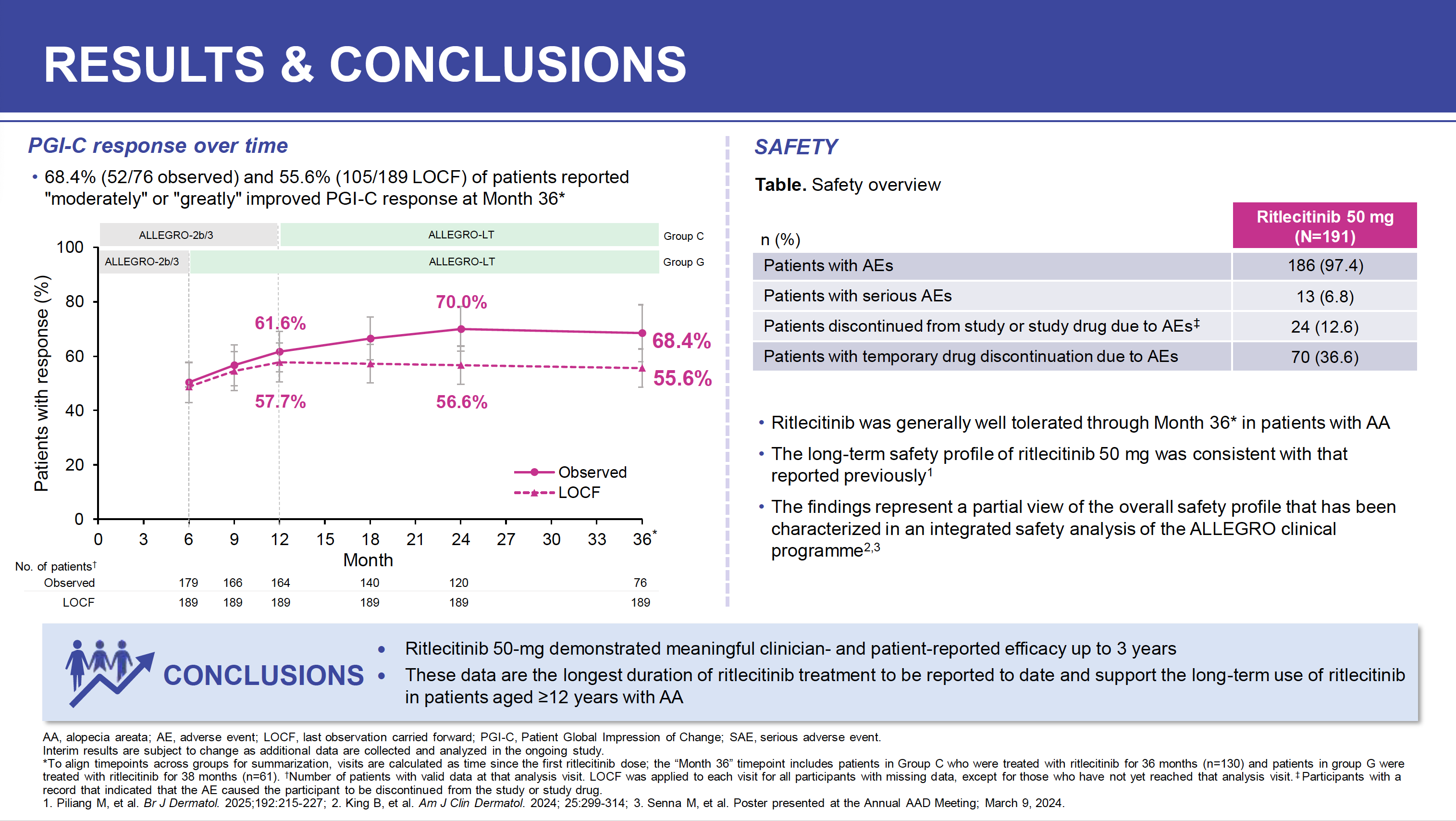
• Pooled data from four clinical trials (comprising 1294 patients and up to a maximum of 72 months and 3539.5 patient-years of exposure), showed consistent safety data previously reported with no new safety signals. The most commonly reported adverse events were SARS-CoV2 positive test, headache and nasopharyngitis. The incidence rates for AEs of special interest were similar to those previously reported.⁶
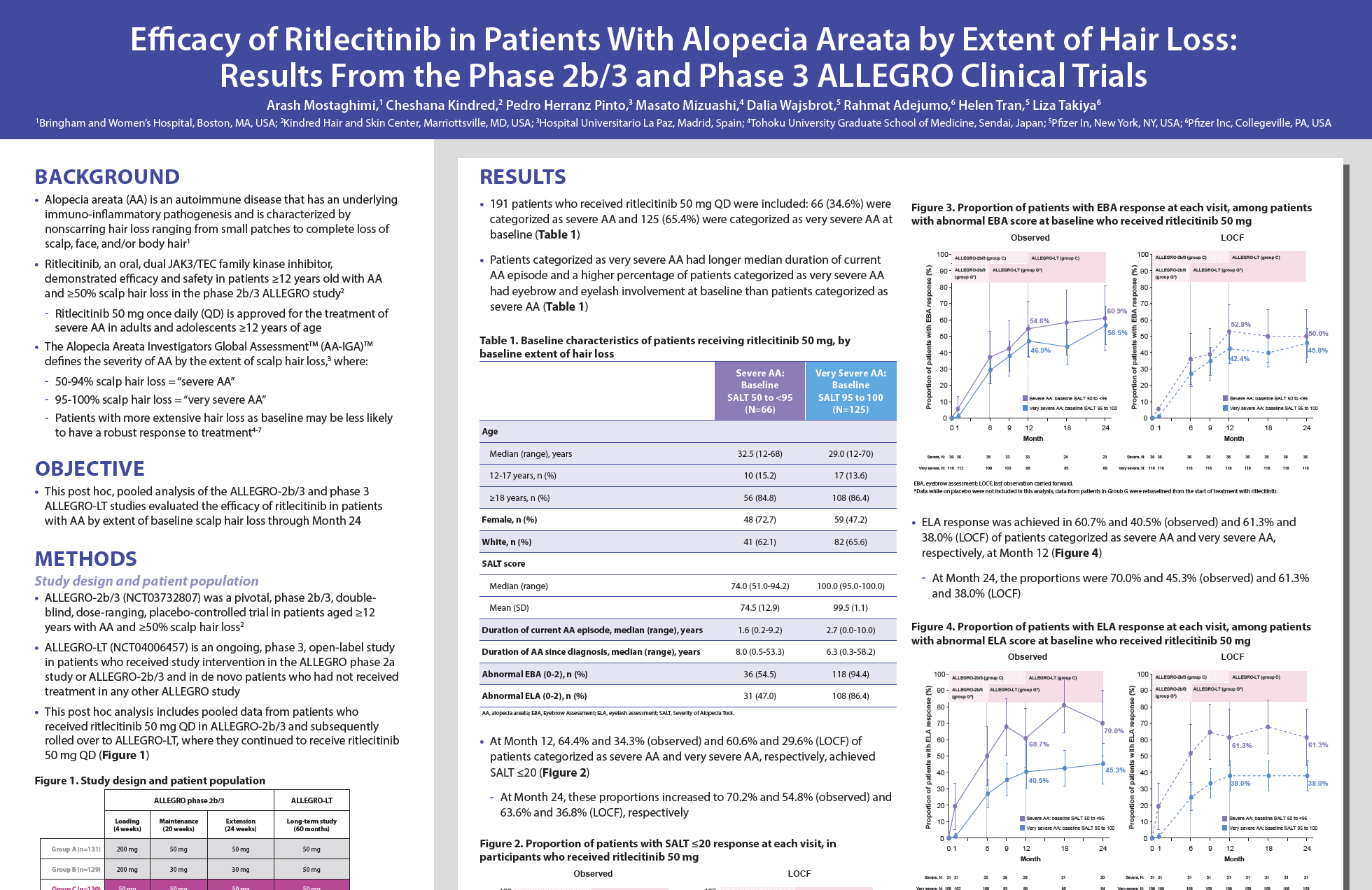
• In a post hoc analysis with 191 patients treated with ritlecitinib 50 mg, 87 (45.5%) were early, middle, or late SALT score <20 responders. Of 87 patients categorized as responders, 81 (93.1%) sustained their SALT <20 response and 47 (46.0%) achieved complete response (SALT 0 at ≥1 timepoint). Factors associated with treatment response included female sex and less extensive and shorter duration of hair loss.²
References:
1. King B, Soung J, Tziotzios C, Rudnicka L, et al. Integrated Safety Analysis of Ritlecitinib, an Oral JAK3/TEC Family Kinase Inhibitor, for the Treatment of Alopecia Areata from the ALLEGRO Clinical Trial Program. Am J Clin Dermatol. 2024 Mar;25(2):299-314.
2. King B, Mirmirani P, Lo Sicco K, et al. Patterns of clinical response in patients with alopecia areata treated with ritlecitinib in the ALLEGRO clinical development programme. J Eur Acad Dermatol Venereol. 2025; 39: 1163–1173.
3. Long-term efficacy and safety of ritlecitinib in adults and adolescents with alopecia areata (AA): 3-year results from the ALLEGRO-LT phase 3, open-label study-Presented at the American Academy of Dermatology (AAD); March 7 11, 2025; Orlando, FL Poster No. 63305
4. Integrated safety analysis evaluating the safety profile of ritlecitinib over maximum 72 months in patients with alopecia areata. Presented at the Fall Clinical Dermatology Conference for PAs and NPs 2025; May 30-June 1, 2025; Orlando, FL
5. Melissa Piliang, Jennifer Soung, Brett King, et al. Efficacy and safety of the oral Janus kinase 3/tyrosine kinase expressed in hepatocellular carcinoma family kinase inhibitor ritlecitinib over 24 months: integrated analysis of the ALLEGRO phase IIb/III and long-term phase III clinical studies in alopecia areata, British Journal of Dermatology, Volume 192, Issue 2, February 2025, Pages 215–227
6. King B, Soung J, Tziotzios C, et al. Integrated Safety Analysis of Ritlecitinib, an Oral JAK3/TEC Family Kinase Inhibitor, for the Treatment of Alopecia Areata from the ALLEGRO Clinical Trial Program. Am J Clin Dermatol. 2024 Mar;25(2):299-314.
EM-GLB-RITA-0049 | December 2025
Page published: 03-Feb-2026