Publication
Knee Health Promotion Option for Osteoarthritic Knee: Cartilage Regeneration is Possible
By a purposeful eradication of all prejudicial factors in the degenerative knee, the jeopardized cartilage will have the potential to regenerate.
Shaw-Ruey Lyu

Knee pain and osteoarthritis (knee OA) impact hugely on the quality of life. Drawing from clinical experience and research studies, we at the School of Medicine, Tzu-Chi University, Taiwan, describe ‘the hidden lesions’ of knee OA and propose the concept of Knee Health Promotion Option (KHPO) for effective treatment. Our team highlight the role of Medial Abrasion Phenomenon (MAP) in the pathogenesis of knee OA, and advocate the use of two techniques to eliminate MAP, reduce knee pain, and improve the quality of life for patients.
The largest joint in our bodies, our knees are under immense strain, carrying the weight of our bodies and continuously undergoing bending and extension. In the elderly, knee osteoarthritis (knee OA) is one of the main causes of mobility issues with an estimated prevalence of 10% in men and 13% in women over the age of sixty, totalling over 250 million people worldwide. The prevalence has increased recently, due in part to higher obesity rates and a sedentary lifestyle. Other predisposing factors for knee OA include a history of knee injury, and age and joint instabilities that increase mechanical stress. Mechanical stresses play a key role in the degradation of cartilage with some stresses affecting cartilage matrix synthesis. Extremely high stress can illicit an ‘injury response’ leading to cell death and increased degradation. In addition to impacting patients’ quality of life, this progressive disease carries a significant financial burden. Thought to be multifactorial in origin, the causes and pathogenesis of knee OA are not fully understood. Pain is a major symptom of knee OA with chronic pain often leading to reduced activity which, in turn, causes weight gain and more pain. Therapeutic interventions exist and successes are higher when disease is treated in the early stages. Patients with end stage disease may undergo total knee arthroplasty or knee replacement.
The medial plica is a synovium fold which is embryonic in origin and if inflamed, thickened, and fibrous, can cause pain. Studies implicate medial plica in the pathogenesis of knee OA and severity of disease is associated with the severity of medial plica fibrosis and the patient’s age. Drawing from our clinical observations and through our research studies, we have described the important but neglected issue of Medial Abrasion Phenomenon (MAP). MAP arises during knee motion, where the medial plica has contact and repetitive friction with the medial femoral condyle opposite it. MAP is one element of what we describe as ‘the hidden lesions’, so called because they are difficult to see during knee arthroscopy because of synovitis. Through a series of studies, we describe and demonstrate the role of MAP in knee OA pathogenesis. We also describe two techniques: Arthroscopic Medial Release (AMR) and Arthroscopic Cartilage Regeneration Facilitating Procedure (ACRFP) for treatment of knee OA. We propose that if implemented early enough, these techniques enable removal of the unfavourable catabolic environment where an imbalance in cartilage metabolism occurs can allow the cartilage to regenerate and repair.

Tzu-Chi Dalin General Hospital
By a purposeful eradication of all prejudicial factors in the degenerative knee, the jeopardized cartilage will have the potential to regenerate.
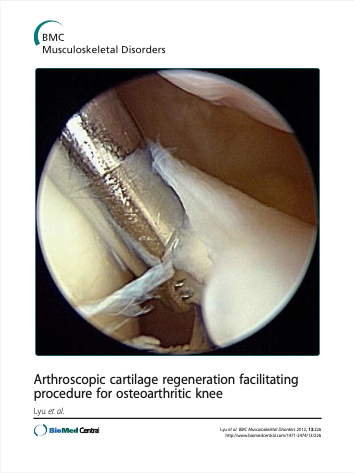
The effectiveness of arthroscopic treatment for osteoarthritic knee is a controversy. This study presents the technique of a novel concept ......
MAS is a cause of pain in patients who have received knee arthroplasties, and MAP should be eliminated to ensure a successful knee arthroplasty.
KHPO targeting on the MAS as a cause of knee OA could provide patients with a high degree of treatment satisfaction.
Medial plica was more commonly found in patients with osteoarthritic knees. The severity of the degeneration was positively correlated with the severity of ...
The close relationship and possible high contact pressure between fibrotic medial plica and medial femoral condyle during knee motion might be a cause of ...
The test results indicated that as patients get older, the fiber content of the medial plica and the Young’s modulus of the plica will increase accordingly.
This observation disclosed the kinematic relationship of the medial plica with the medial femoral condyle during knee motion in vivo.
The findings of this study support the beneficial effect of some surgical procedure that would remove the pathologic medial plica for the treatment of knee OA.
Pannus-like tissue and the plica express IL-1β and MMP-3. Moreover, MMP-3 mRNA and protein expression in the plica may contribute to the pathogenesis of OA.
The results suggest that medial plica and pannus-like tissue may be involved in the process of cartilage degradation in medial compartment OA of the knee.
significant clinical improvements could be achieved with surgical results of ACRFP, and shifting of the foot pressure medially may be related to ...
Despite medical advances, mainstream medicine has yet to identify a cause for knee OA. Our multidisciplinary research and more than a decade of clinical expe...
Degeneration is a result, not a cause, of knee osteoarthritis (knee OA)…This rubbing is a cause of knee OA…We have pinpointed a cause of knee OA, so we can n...
Background The effectiveness of arthroscopic treatment for knee osteoarthritis (OA) has been subject to debate. This study presents an innovative concept of art