
Interview
Roundtable: Insights from 2025
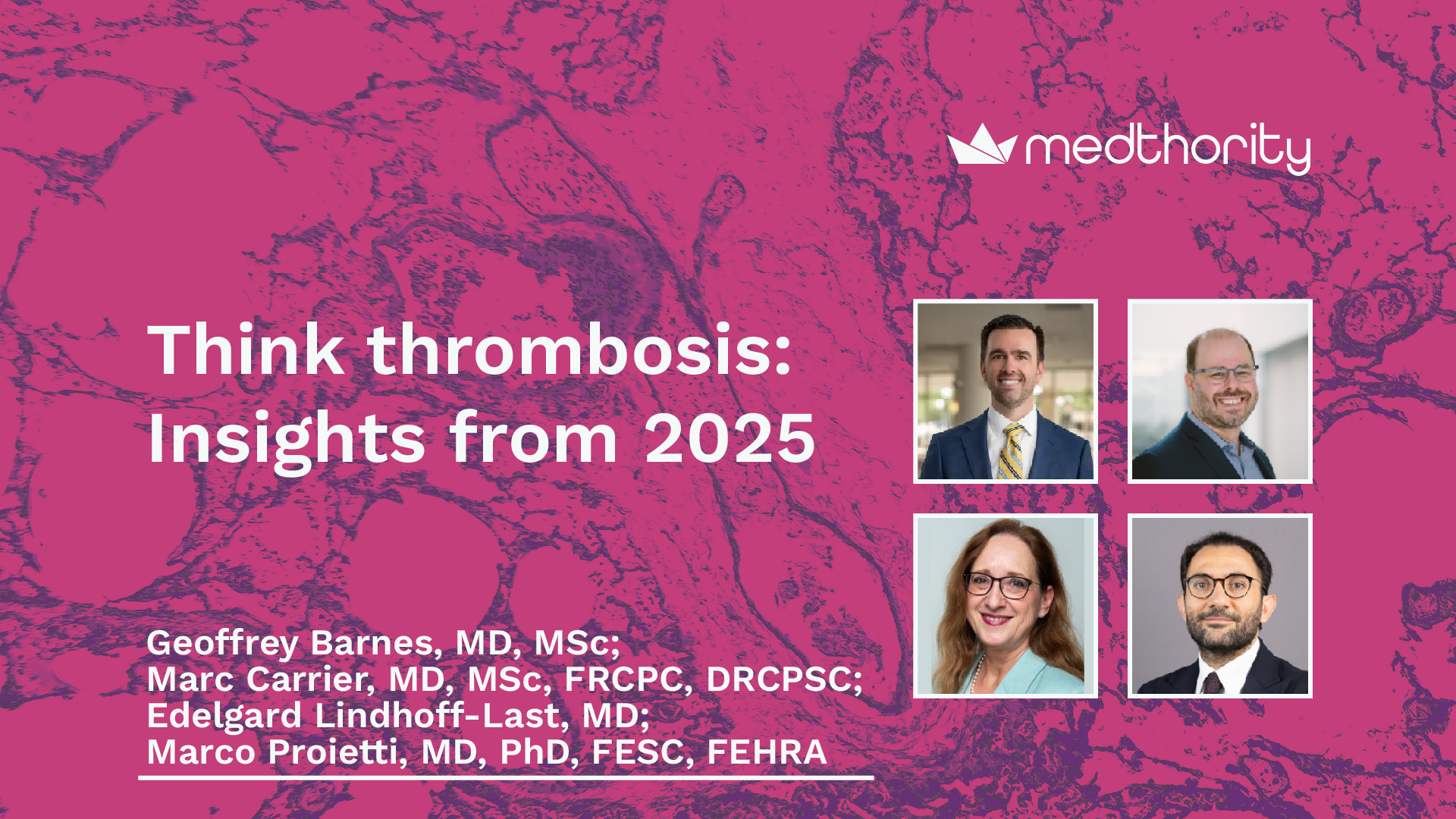
Watch Geoffrey Barnes, Marc Carrier, Edelgard Lindhoff‑Last and Marco Proietti discuss thrombosis trial data and real‑world patient care in this roundtable.
Medthority

Clinical trial data from 2025 provide important insights into the management of venous thromboembolism (VTE) and atrial fibrillation (AF), with a strong focus on balancing long-term protection against bleeding risk.
In VTE, studies such as RENOVE, API‑CAT, and HI‑PRO explore extended anticoagulation strategies across different patient populations.
RENOVE evaluates whether reduced‑dose direct oral anticoagulants (DOACs) offer comparable long‑term protection to full doses in patients with unprovoked or high-risk VTE. API‑CAT focuses on cancer‑associated thrombosis, showing that low‑dose apixaban can maintain efficacy while reducing bleeding.
HI‑PRO challenges traditional definitions of “provoked” VTE, suggesting that patients with persistent risk factors, including obesity or chronic inflammatory disease, may still benefit from extended low‑dose anticoagulation. In AF, trials examine a move toward simplified treatment in selected patients.
Trials such as OPTION, CLOSURE‑AF, and OCEAN compare left atrial appendage occlusion (LAAO) with anticoagulation and evaluate antithrombotic strategies after AF ablation.
Studies including ADAPT AF‑DES and OPTIMA‑AF examine whether patients require long‑term combination antiplatelet and anticoagulant therapy after coronary stenting.
Thrombosis management is rapidly evolving, and the 2025 evidence base offers timely guidance on how to optimize long-term prevention of VTE and AF–related stroke while minimizing bleeding risk.
Extended anticoagulation has traditionally been challenging because of concerns about overtreatment and hemorrhage. However, recent trials demonstrate that reduced-dose DOAC strategies can preserve efficacy with improved safety in cancer-associated, unprovoked, and persistently provoked VTE. This supports a shift toward more personalized, risk-adapted, long-term therapy.
In AF, emerging data suggest that simplified antithrombotic regimens may safely replace combination therapy for patients after ablation, potentially reducing bleeding without sacrificing protection from thromboembolic events. Procedural alternatives like LAAO continue to be evaluated for patients with high bleeding risk or contraindications to anticoagulation.
Together, these findings strengthen the case for shared decision-making based on patient risk, treatment tolerance, and long-term outcomes.
Key takeaways:
Watch Geoffrey Barnes, Marc Carrier, Edelgard Lindhoff‑Last and Marco Proietti discuss thrombosis trial data and real‑world patient care in this roundtable.
Data presented at ESC 2025 address VTE risk in pregnant women, people with provoked VTE and added risk factors, and patients with renal impairment.