Publication
Ten questions concerning well-being in the built environment
Peer-reviewed publication presenting views of ten experts from academia and the building industry on promoting well-being in the built environment
Lily Wang

Humans spend the majority of their time in built environments, and the quality of the indoor environment (such as the acoustics, indoor air quality, lighting, and thermal conditions) impacts human comfort, performance, and well-being. Our research group has been studying the impacts of indoor environmental conditions on humans. Of particular interest is how these conditions may interact with each other.
Designing and maintaining healthy indoor built environments can result in greater comfort, better performance, and improved well-being for humans.
My colleagues and I in the Durham School of Architectural Engineering and Construction at UNL are uniquely positioned to approach this research problem, collaboratively with multi-disciplinary perspectives. The fact that many of us are based in Omaha is also a major benefit, as it allows our research group to partner with the prestigious architectural engineering design firms headquartered here.

University of Nebraska System
Peer-reviewed publication presenting views of ten experts from academia and the building industry on promoting well-being in the built environment
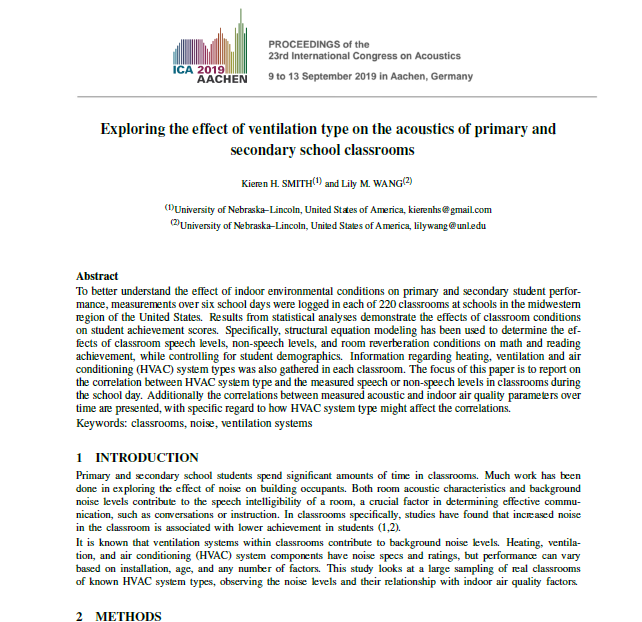
Conference paper from the 23rd International Congress on Acoustics (ICA), Aachen, Germany (September 2019)
ASHRAE Transactions Paper, presented at ASHRAE Annual Meeting, Albuquerque, NM (June 2010)