

Publication
Impact Behavior of Fiber Reinforced Concrete with Polypropylene Fibers and Carbon Fiber–Reinforced Polymers
Journal of Testing and Evaluation
Hamed Arshadi
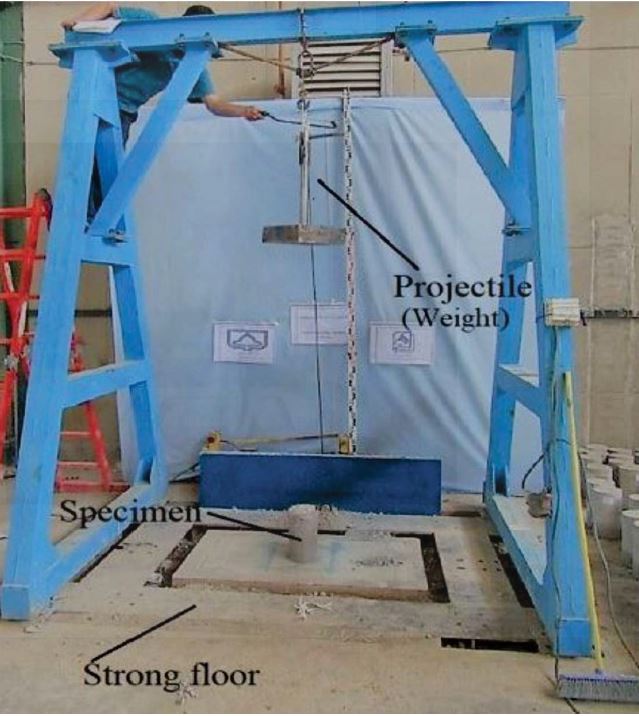
In this study, the influences of bidirectional carbon fiber–reinforced polymer (CFRP) confinement along with polypropylene fibers on the impact resistance of concrete samples were experimentally studied. Forty-nine concrete cylindrical samples (with compressive strengths of 20, 30, and 40 MPa) with polypropylene fibers (with content ratios of 0 %, 1 %, 1.5 %, and 2 %) were subjected to weight (46.7 and 66.8 kg) dropping at a height of 1.6 m above the cross-section of the sample. Moreover, half of the samples were tested with CFRP confinement. The number of weight releases required to destroy the samples and the weights of the samples after each release were recorded. The results indicated that the concrete without fibers and fiber-reinforced polymers (with compressive strengths of 20, 30, and 40 MPa) did not have sufficient impact resistance and were swiftly destructed. However, as the content ratios of polypropylene fibers increased, the number of cracks and weight droppings (to reach 70 % of the initial sample weight) increased. Moreover, it was observed that the concrete samples wrapped with the CFRP sheets also withstood impact loading better than fiber-reinforced concrete samples without the confinements. Besides, it was indicated that the prevailing failure mode of the samples with CFRPs was CFRP rupturing. Finally, it was observed that the more the compressive strength of concrete, the more the impact resistance. A. Kheyroddin, H. Arshadi, and J. Salehzade, "Impact Behavior of Fiber-Reinforced Concrete with Polypropylene Fibers and Carbon Fiber–Reinforced Polymers," Journal of Testing and Evaluation 49. Published ahead of print, 23 April 2021, https://doi.org/10.1520/JTE20200670.
RC structures can be subjected to impact loading because of several possible cases, such as terrorist attacks, vehicle and ship collisions, wind- and water-carried debris, etc. Thus, it is important to construct RC structures that can resist impact loading to decrease human casualties and reconstruction expenses.
As discussed in the earlier paragraphs, both fibers and FRPs can improve the impact resistance of RC structures. However, there are not enough experimental and numerical studies focusing on the effects of both PP fibers and CFRPs on the impact behavior of different types of RC specimens. Then, it is necessary to fill this gap more and study the interaction of fibers and FRPs with each other to improve the impact resistance of RC specimens. The goals of this study are to find a more appropriate strategy (using fibers, CFRPs, or both of them) and optimum fiber content ratios to improve the impact resistance of RC members. In this study, bidirectional CFRP confinement along with PP fibers was used to investigate their effects on the impact resistance of concrete samples. Forty-nine concrete cylindrical samples (150 × 300 mm2) with the fibers (with the ratios of 0 %, 1 %, 1.5 %, and 2 %) were tested at the age of 28 days. The compressive strengths of concrete samples were 20, 30, and 40 MPa at 28 days. Besides, half of the samples were tested with the CFRP confinement (wrapping), and the other half were tested without the confinement. This dropping cycle continued until at least 30 % of the sample weight was reduced and the samples were destroyed. The results indicated that the concrete without fibers and FRPs (with the compressive strengths of 20, 30, and 40 MPa) did not have sufficient impact resistance and were quickly destructed. However, as the content ratios of the PP fibers increased, the number of cracks and the weight droppings to reach 70 % of the initial sample weight increased, too. Moreover, it was observed that concrete samples wrapped with CFRP sheets also withstood impact loading better than FRCs and were destructed with the greater numbers of droppings. It was also shown that the prevailing failure mode of the samples with FRPs was FRP layer rupturing or debonding. Finally, it was observed that the more the compressive strengths of concrete, the more the impact resistance.

Semnan University of Medical Sciences and Health Services
Journal of Testing and Evaluation