

Publication
Experimental Study on the Failure Traits of Frames with High-Strength Reinforcements
Doi: 10.17706/ijmse.2021.9.1.8-14
Hamed Arshadi
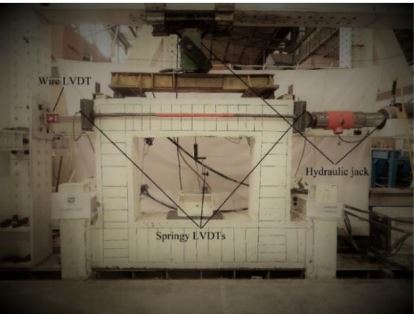
Using high-strength reinforcements (HSRs) has several benefits in terms of financial and execution onsiderations. However, possible effects of HSR application on structural behavior such as ductility, energy dissipation, and damage process are not fully known for the researchers. In this study, firstly the HSR effects on the cyclic behavior, cracking process, and damage indices of special moment frames were experimentally studied under cyclic loading. Four special moment frames with HSRs (with the yield strengths of 500 and 580 MPa) were designed based on the special seismic provisions of ACI 318-19. These frames were subjected to cyclic loading and their responses were acquired. The results showed that using HSRs led to increasing the width and depth of the cracks. Then, two methods of calculating damage indices (introduced by[8].) were applied based on the experimental results. Concerningdamage indices, it was observed that using HSRs generally resulted in increased damage indices of the specimens.
There are many studies that have focused on the behavior of individual-and dual-lateral resisting systems in reinforced concrete (RC) frames[1]-[4]. The performance of reinforced concrete as a material for designing frames exposed to severe environmental conditions was improved by the development of high-performance concrete (HPC) and High-strength reinforcement (HSR). HSR application has several benefits, such as decreasing the labor and material costs, peripheral expenses (like the transportation and overhead expenses), reducing construction time,and facilitating the construction procedure. However, there are considerable impediments against the HSR application, such as increasing the crack width under service loads, the brittle failure phenomenon, the difficulties of the HSR production with proper ductility . Then, the application of HSRs is restricted in the special moment frames and shear walls by codes. This restriction to some extent is because of the lack of information and experimental data about the possible effects of HSR application in the frames and shear walls. Accordingly, it is essential to study HSR effects on them. The damage process and even stiffness degradation of reinforced-concrete (RC) members can be monitored by using damage indices (DIs). The damage indices can have either cumulative or non-cumulative nature. Promis et al.carried out seismic damage analysis for RC buildings. They proposed formulations for damage indices based on the different parameters such as energy and displacement.
n this study, the effects of HSRs on the failure mechanism of four RC frames were investigated based on the different types of damage indices. These frames were designed based on the special seismic provisions of ACI318-19 . Several structural systems can resist lateral forces such as shear walls, moment frames, etc.These systems have restrictions in terms of the height of structures,in which they are applied . Besides, the application of HSR in the special moment frames and shear walls is challenging[17], [18]. Studying the HSR effects on the seismic performance of special moment frames is essential and recommended by several technical sources, see[9]. With regard to these facts, four special moment frames, which had the same geometric characteristics and equivalent amounts of longitudinal and transverse reinforcements, but with discrepant yield strengths (500 and 580 MPa) were constructed. The specimens were tested under cyclic loading and their responses were recorded. Then, the damage indices introduced by Promis et al.[8]were calculated in this study. One of these methods is based on displacements and the other method is based on energy absorption. The results indicated that using HSR increased the width and depth of the cracks in the specimens. It must be reminded that the slope of damage diagrams shows the velocity of damage distribution. The results of the damage indices showed that the velocity of the damage propagation in case of applying HSRs as both the longitudinal and transverse reinforcements was the most among the specimens. Furthermore, applying HSRs as longitudinal reinforcements decreased the velocity of damage propagation in comparison to applying them as just the stirrups.

Semnan University of Medical Sciences and Health Services
Doi: 10.17706/ijmse.2021.9.1.8-14