

Publication
Experimental investigation into the failure process of exterior beam-column joints with high-strength reinforcements - IOPscience
Citation H Arshadi et al 2020 IOP Conf. Ser.: Mater. Sci. Eng. 910 012007
Hamed Arshadi
Although using high-strength reinforcements (HSRs) have economical and execution benefits, their possible negative effects on the performance of structures such as ductility, energy dissipation, and damage process caused them to be restricted by building codes in seismic areas. In this research, the HSR effects on the cyclic behavior, cracking process, and damage indices of exterior beam-column joints were experimentally investigated under cyclic loading. Three exterior beam-column joints with HSRs (with the yield strengths of 500 and 580 MPa) were designed based on the special seismic provisions of ACI 318-19. These specimens were subjected to cyclic loading and their responses were obtained. The results showed that using HSRs led to increasing the width and depth of the cracks. Then, two methods of calculating damage indices (introduced by Promis et al., 2009) were applied based on the experimental results. Considering the damage indices, it was observed that using HSRs increased the damage indices of the specimens and the damage distribution in them.
Several structural systems resist earthquake-induced forces such as shear walls, moment frames, and dual systems (moment frames with shear walls). Although there are many studies on performance of the lateral resisting systems [1-5], but these systems have some usage limitations such as height of structures, etc. [6]. For instance, special moment frames along with shear walls are earthquake-resisting systems that high-strength reinforcement (HSR)‒steel reinforcements with the yield strengths greater than 500 MPa‒ application is restricted in them due to possible repercussions of HSR application [7,8]. There are considerable challenges against the HSR application such as increasing the crack width, the brittle failure, decreasing the ductility and energy dissipation. On the other hand, HSR application has several benefits, such as diminishing the labor and material costs, reducing construction time and facilitating the construction procedure [6]. Damage indices can be calculated based on different parameters such as strain, stress, displacement, dissipated energies, stiffness, and ductility. Several researchers have proposed Damage indices (DI) for different types of structures during recent years. These indices have been modified and calibrated by passing the time.
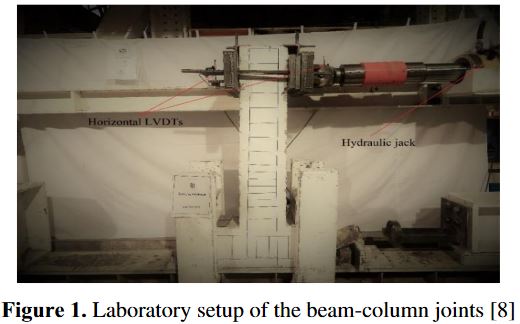
In this study, the HSR influences on the failure process and damage indices of three exterior beam-column joints were studied. Three beam-column joints were designed based on the special seismic provisions of ACI318-19 . The specimens were constructed with the same geometry and equivalent amounts of the reinforcements. The specimens were tested under cyclic loading. The experimental results showed that the HSR application decreased the cracking forces and increased the crack propagation in the specimens. Besides, the damage indices introduced by Promis et al. (2009) were used to study the damage behavior of the joints. One of these methods was based on the displacements and the other one was based on the energy absorption. The slope of damage diagrams indicates the velocity of damage distribution in the specimens. The damage indices showed that the velocity of the damage propagation in case of applying HSRs as both the longitudinal and transverse reinforcements was the most among the beam-column joints. Also, applying HSRs as longitudinal reinforcements decreased the velocity of damage propagation in comparison to applying them as just the stirrups.

Semnan University of Medical Sciences and Health Services
Citation H Arshadi et al 2020 IOP Conf. Ser.: Mater. Sci. Eng. 910 012007