Other
ERRC Website
The Environmental Radioactivity Research Centre (ERRC) at the University of Liverpool.
University of Liverpool Faculty of Science and Engineering
The Environmental Radioactivity Research Centre (ERRC) at the University of Liverpool is a world-leading centre of excellence in the field of dating sediments by 210Pb. This natural radionuclide (half-life 22.3 years) is ideally suited to dating records spanning the past 150 years, the period of greatest impact of human activity on the natural environment.
Currently led by Dr Gayane Piliposyan and Emeritus Professor Peter Appleby, the ERRC has continued to play a world-leading role both in the continuing development of the 210Pb method, and its application to environmental research programs around the world. An essential feature of its operations has been an ability to draw on a wide range of interdisciplinary skills vital to this work. Personnel associated with the ERRC include staff from the Departments of Mathematical Sciences, Geography, Physics and Earth Sciences at the University of Liverpool.
Researchers at Liverpool University played an important role in the development of the methodology, and in the late 1970s and early 1980s successfully used it in a number of studies concerned with land use changes. The University of Liverpool Environmental Radioactivity Research Centre (ERRC) was established in mid-1980s in response to a rapidly growing need for a specialised 210Pb dating facility. One of its first projects was a major role in a study of the causes of “acid rain”. Reconstructions from sediment records were used to show that increased levels of lake water acidity beginning in the late 19th century were driven by emissions from coal-fired power stations. An important impact was the fitting of scrubbers to chimney stacks to remove those emissions.
Current research themes at the ERRC include: • Radiometric dating of lake, marine and coastal sediments and peat cores • Modelling the transfer of radionuclides through the atmosphere and in catchment/lake systems • Reconstruction of historical levels of environmental pollution from sediment records • Studies of catchment erosion • Studies of Chernobyl fallout
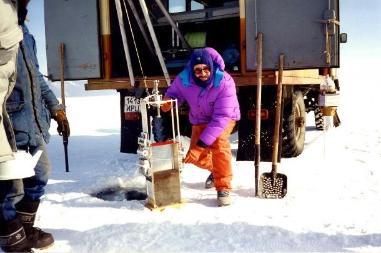
Environmental Policy is crucially dependent on good evidence as to the present status of the environment, how this has changed in the past, and what are the drivers of those changes. Since active monitoring is often sparse, intermittent, and short term, policy makers are increasingly reliant on information from environmental records stored in natural archives such as lake sediments, marine sediments and peat bogs. Sediments laid down on the bed of a lake contain a wealth of information about the contemporary state of the environment including water quality, soil erosion, land use, atmospheric pollution, and climate. Sediment cores retrieved from the lake can be used to reconstruct records of how the status of the environment has changed through time, though key to this is a reliable means for dating the sediments.
Identifying environmental problems and obtaining reliable information on the extent to which they are the result of human activity is one of the most difficult aspects of providing evidence to governments and environmental agencies responsible for making environmental policy. The 210Pb dating methodology developed by the ERRC helps provides a solution to that problem due to the wide range of issues to which it can be applied.
Since its establishment the ERRC has worked on a wide range of environmental research projects from around the world, including: • SWAP (Surface Water Acidification) Project funded by the Royal Society • AL:PE, MOLAR and EMERGE projects on atmospheric pollution in Europe funded by the EU • TRANSURANICS project studying the large‑scale and long‑term environmental behaviour of transuranic elements in European surface water systems funded by the EU • CASSARINA project on recent environmental change and human impact on North African wetland lakes funded by the EU • BICER (Baikal International Center for Ecological Research) funded project studying sediment records in Lake Baikal • SCP (spheroidal carbonaceous particles) project for establishing the reliability of SCP records as chronostratigraphic markers in recent lake sediment funded by NERC • Project on the impact of antifoulant paints in UK inland waters funded by Natural England, DEFRA and NERC • Western Airborne Contaminants Assessment project to evaluate the ecological impact of airborne contaminants in US national parks funded by the United States Environmental Protection Agency • Landscape restoration project on Fire Island in New York funded by the US National Park Service
The ERRC has also carried out sediment dating projects for a large number of national and international research groups working on problems concerned with water, air and soil pollution, and environmental change generally. Over the past five years they have included colleagues from Alfred Wegener Institute Helmholtz Centre for Polar and Marine Research, Potsdam, University of Oslo, Ghent University, University of Bergen, University College London, Museo delle Scienze, Trento, Italy, Lakehead University, Canada, University of Alberta, University of Helsinki, University of Potsdam, and University of Bordeaux.
Although much of this work has been concerned with obtaining a better understanding of the extent and nature of environmental change, a significant number have been directly concerned with influencing and improving environmental policy and regulations and thereby reducing levels pollution and carbon emissions. Three recent examples have been refinements to Norwegian governmental guidelines for water quality (2018), re-allocation of governmental resources tackling environmental change in Alberta, Canada (2017), and the introduction of the first localised carbon budget in Canada (2020).
Although man’s activities have had a significant impact on the environment since ancient times, the level and extent of the impact has increased dramatically during the past 200 years. The introduction of 210Pb dating in the 1970s played a crucial role in our ability to reconstruct detailed records of those impacts, and develop methods for mitigating them. In developing the 210Pb method the work carried out at Liverpool has highlighted the importance of interdisciplinary cooperation in environmental research.
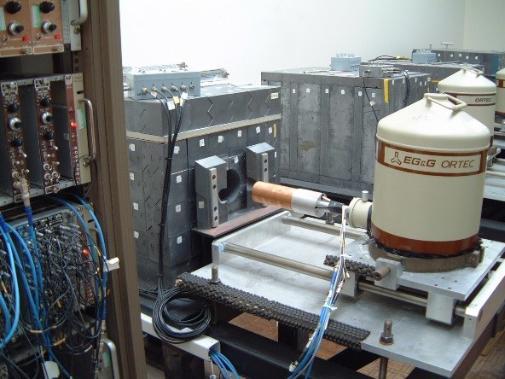
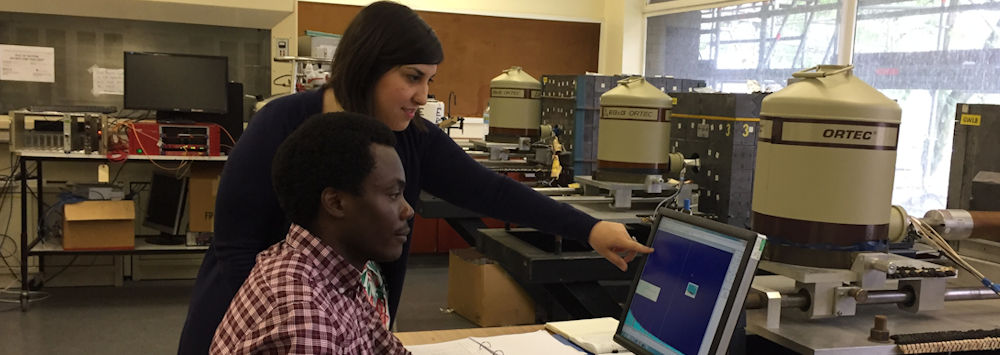
Built upon this spirit of collaboration, the Liverpool University Environmental Radiometric Laboratory is a truly world-leading facility for measuring 210Pb and other environmental radionuclides. The expertise developed at Liverpool and its leading role in the radiometric dating of recent sediments has been recognised internationally by the large number of projects that have drawn on the expertise of the ERRC.
The Environmental Radioactivity Research Centre (ERRC) at the University of Liverpool.
The ERRC has carried out 210Pb dating of lake and marine sediments and peat bog cores for a wide range of academic research institutes.