How Copepods Can Eat Toxins Without Getting Sick: Gut Bacteria Help Zooplankton to Feed in Cyanobacteria Blooms
Cyanotoxin biodegraders in copepod guts convey fitness advantage to their hosts during cyanobacteria blooms in the Baltic Sea.
Elena Gorokhova

Project Team Elena Gorokhova & Rehab El-Shehawy (ACES) Klas Udekwu (SLU) Leopold Ilag (MMK)
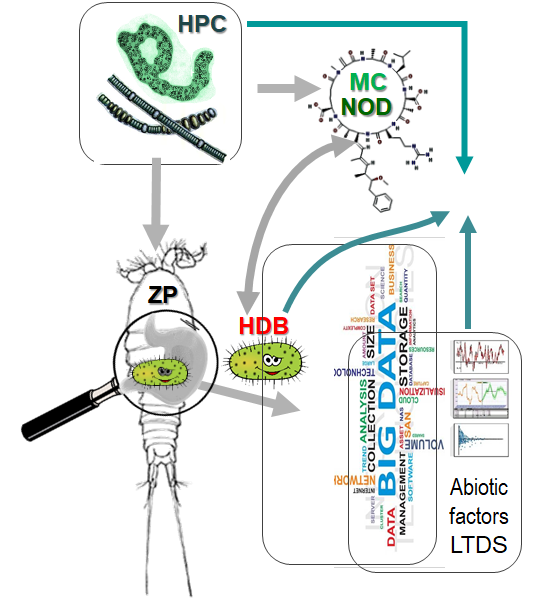
Blooms of filamentous cyanobacteria produce hepatotoxins (nodularin, NOD, and microcystin, MC) that are bioaccumulative and potentially harmful for animals and humans. At the same time, these cyanobacteria are often a valuable food source for grazers, because they circumvent summer nitrogen limitation by fixing dissolved nitrogen and generate a supply of nitrogen-rich food. The evidence is accumulating that both NOD and MC can be efficiently degraded by heterotrophic bacteria, thus regulating toxin levels in the water and the food webs. We propose that such bacteria can become an integral part of the gut microbiome in the grazers exposed to cyanobacteria, which may convey a selective advantage for the hosts.
We seek to understand the role of biodegraders in cyanotoxin dynamics and the outcome of zooplankton-cyanobacteria interactions using Baltic plankton species as a model system. By exploiting existing metagenomics and environmental data and filling gaps through targeted laboratory and field studies, we aim to quantify the ecological and evolutionary role of biodegradation that would be fully applicable to any system experiencing frequent blooms of harmful algae.
In the environment, microbial degradation is the main route for cyanotoxin breakdown by heterotrophic bacteria. However, despite its potential importance, hepatotoxin biodegradation is not considered when evaluating food-web consequences of the blooms and their potential impact. We are initiating a multidisciplinary research program to understand drivers of cyanotoxin dynamics in the Baltic Sea.
Cyanotoxin biodegraders in copepod guts convey fitness advantage to their hosts during cyanobacteria blooms in the Baltic Sea.