Publication
Task layer multiplicity as a measure of community level health
This article suggests that we can improve our understanding of individual well-being by shifting our focus to community-level well-being, while respecting indiv
P. Fraundorf

Now may be a good time to explore apolitical strategies for working together. We might begin by taking into account that:
(i) new types of communication media are able to over-drive emotions, until we learn to use them effectively,
(ii) tribal narratives (looking outward from gene-pool i.e. family boundaries) may under these conditions eclipse stories of collaboration on shared issues (looking outward from idea-pool i.e. cultural boundaries),
(iii) models & measures of layered complexity in human communities might help us guide our way to finding what works in context of these shared issues.
We can hopefully now all agree on these things, and perhaps work together to put these insights to use.
Media in general are being terribly misused, with a continuing focus on what people disagree on, and no discussion at all on the challenge of adapting to new media in part by learning to tamp down your emotional reaction (and behavior) to stuff that might upset you. This happened across the world with radio in the last century, but now (with the internet) we have multiple participants with access to atomic bombs and ICBMs.
This began as a search for healing narratives, and a physical look at modes for information (subsystem-correlation) storage via the occupation of dynamical states by metazoan individuals, i.e. in biological niches. For instance, a technical report in 1989 on physical observables suggested that buffered correlations fall into only a half-dozen categories, but that robust strategies for quantification were not yet available. Connections to the emergence of broken symmetries, and to simplex models for tracking developments, only developed later.
This article suggests that we can improve our understanding of individual well-being by shifting our focus to community-level well-being, while respecting indiv
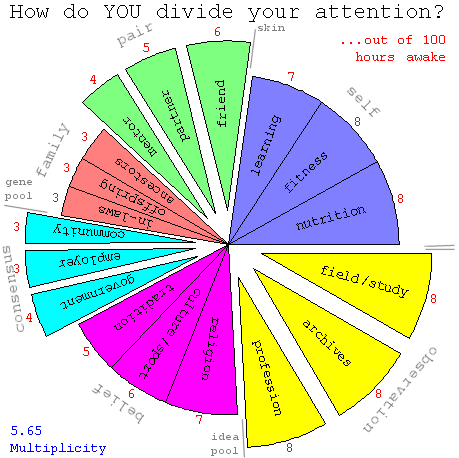
An inventory of niche structures focused in and out from the boundaries of skin, family, and culture might serve to quantify layered complexity in communities.
A cross-disciplinary look at possible tools for healing the global narrative, before it is too late.
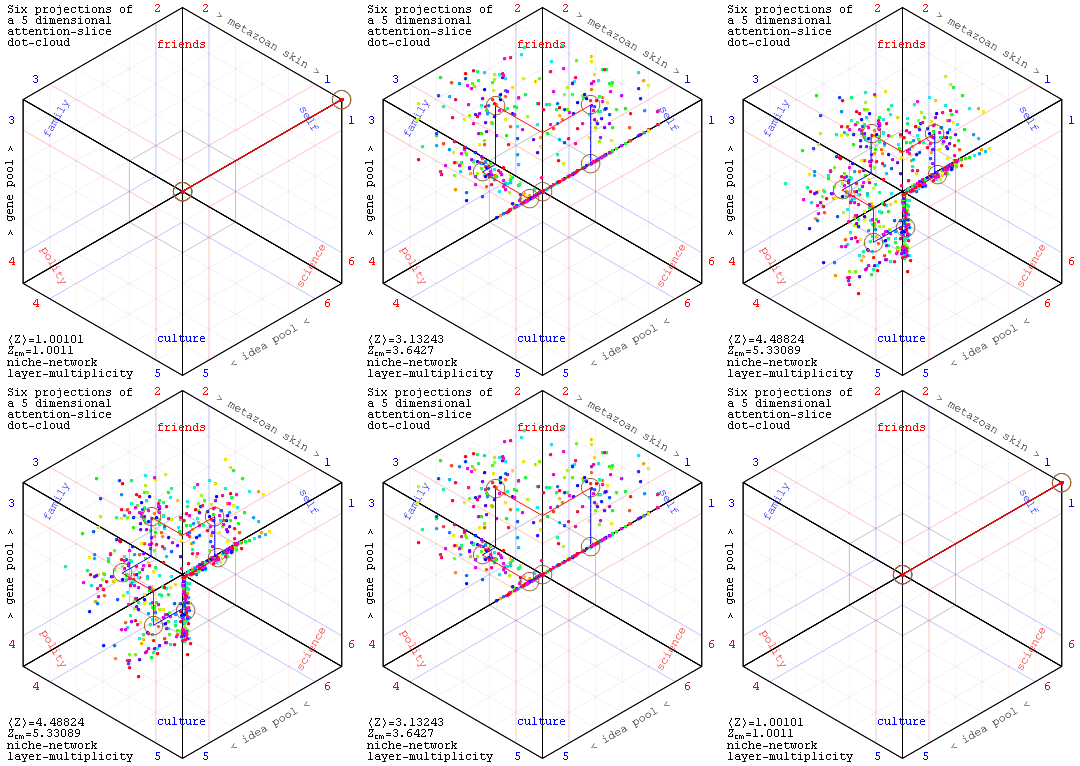
A hexagonal community dot-cloud shows the attention-slice distribution of 100 community members evolving toward increased, & then decreased, layer multiplicity.
The corners of both the turquoise and orange community triangles are projections into 2 dimensions and 3 vertices of a 5-dimensional simplex with 6 vertices.
This "lay" discussion of some intuitively accessible notes on the role of symmetry breaks in community-level health: Part of a picture with much deeper roots.
How might we encourage communications that nurture correlations which look both in and out from the boundaries of skin, family & culture?
Perhaps not wrong, but it misses the idea that blind praise/vilification of groups of people is f4 regardless of topic, & oft tramples over f1-3, f5-6 issues.
This illustrates a subset of the many topics that may get ignored (or worse) if our communication attention-focus is dominated by a single (e.g. cyan f4) layer.
Life's layered complexity is built on correlations that look in/out from molecule edge, cell wall, tissue surface, metazoan skin, gene-pool & idea-pool edges.
Less-familiar variables underlie the utility of more-familiar variables in today's classrooms. A few examples are outlined here.
Gene-pool and idea-pool lifeforms have been long evolving side-by-side with multicelled organisms, but we may not be giving them credit for their independence.
Beyond group selection, we here recognize gene-pool and idea-pool lifeforms that partner with organisms, but evolve independently for better & possibly worse.
Code-pool lifeforms, built on organisms, play a surprising role. Picture adapted from a figure in the book ProSocial. Narrative provided by NotebookLLM.
This is one of over two dozen video slide-shows on modernizing educational content. This one is also part of the playlist on "from coin flips to culture wars".