
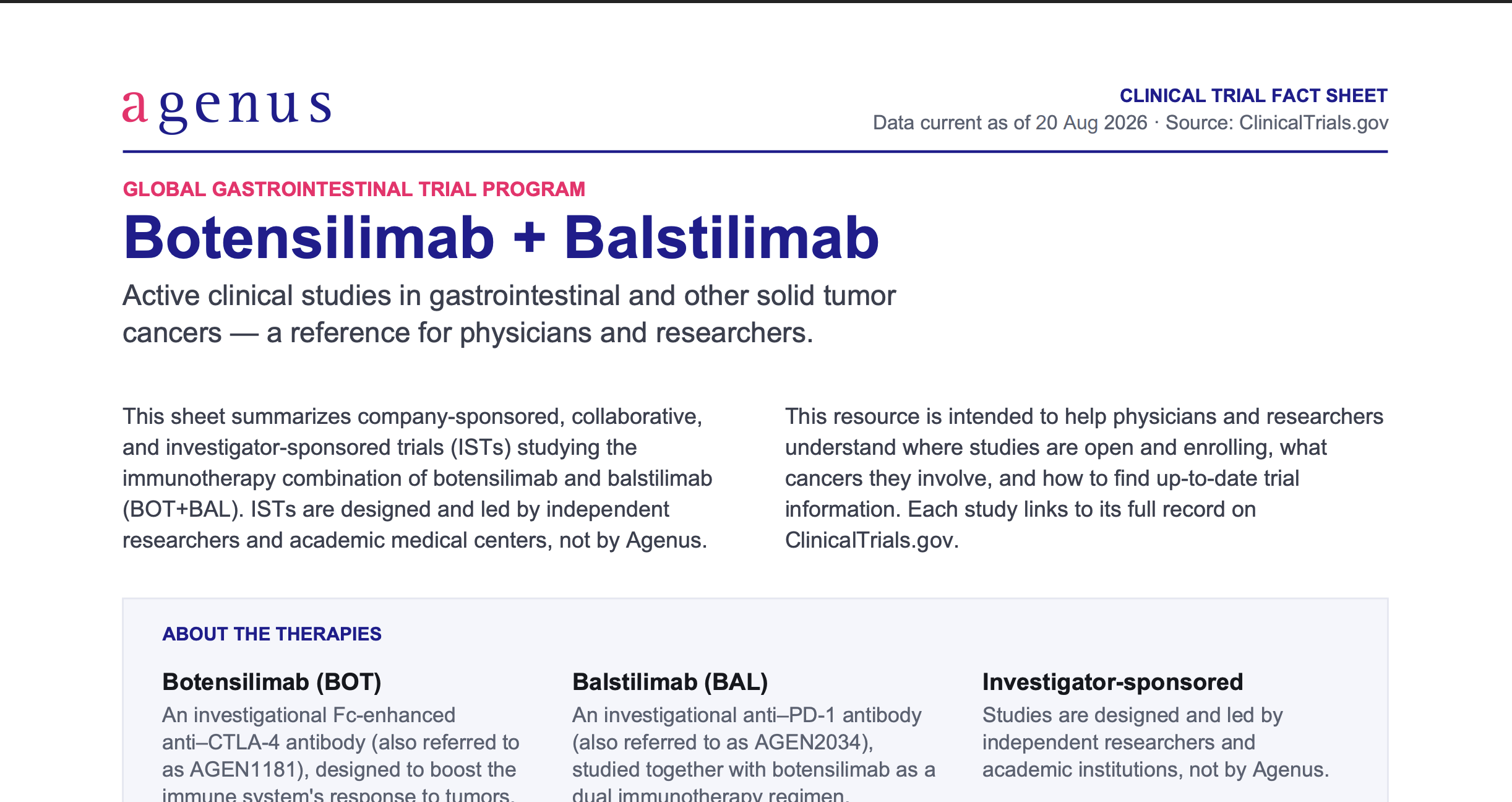
Infographic
Botensilimab + Balstilimab Clinical Trial factsheet
[Aug 2026] Active clinical studies in gastrointestinal and other solid tumor cancers — a reference for physicians and researchers
Agenus

Agenus is committed to expanding patient access to BOT+BAL through regulatory approvals, clinical trials and authorized early-access pathways. Following the first marketing authorizations for Botvymo® (botensilimab) and Evamplix® (balstilimab) in Armenia for eligible patients with previously treated MSS metastatic colorectal cancer, access is also available through select early-access programs where permitted by local regulations. BOT+BAL remains investigational outside Armenia and is not approved by the U.S. Food and Drug Administration (FDA).
For eligible patients who cannot participate in a clinical trial and have exhausted available treatment options, BOT+BAL may be accessible through physician-initiated, regulatory-authorized pathways in certain countries:
In France, the national Autorisation d’Accès Compassionnel (AAC) provides hospital-based, reimbursed access governed by a standardized, national protocol. Adult patients with the following conditions may be eligible: MSS metastatic colorectal cancer without active liver metastases; treatment-refractory or -resistant ovarian, fallopian-tube or primary peritoneal cancers; advanced or metastatic soft-tissue sarcomas. EU/EEA patients may also be able to use cross-border care, subject to local approval and insurance arrangements.
Paid named-patient programs: In select countries outside the United States, treating physicians may request BOT+BAL for individual patients where permitted by local regulations. Eligibility, treatment location, regulatory requirements and payment or insurance coverage vary by country. Cross-border care may be possible in certain circumstances.
United States: Clinical trials are currently the primary pathway for access to BOT+BAL. Decisions regarding any expanded- or early-access requests are governed by regulatory requirements, clinical considerations and the need to preserve ongoing clinical development.
Outside approved use in Armenia, access requests must be initiated and medically managed by a treating physician. Availability is not guaranteed and depends on individual eligibility, local regulations, institutional participation and product supply.
Patients who have exhausted available therapies may have limited treatment options and may not be able to participate in a clinical trial. Authorized access pathways provide a structured mechanism through which treating physicians can request investigational BOT+BAL for appropriate patients where local regulations permit.
These programs do not replace controlled clinical trials or regulatory review. They complement clinical development by supporting responsible access, safety monitoring and structured collection of real-world experience while BOT+BAL continues to be evaluated.
To explore more about BOT+BAL, including recent and planned research, click below on Agenus BOT+BAL Immunotherapy Research Showcase.
Page published: 12-Nov-2026
[Aug 2026] Active clinical studies in gastrointestinal and other solid tumor cancers — a reference for physicians and researchers
A full set of resources and contact information to provide clinicians with information about BOT+BAL access pathways

In October 2026, BOT+BAL reached an important milestone with its first marketing authorizations in Armenia, where Botvymo® (botensilimab) and Evamplix® (balstilimab) were approved for use in combination in eligible adults with microsatellite-stable (MSS) metastatic colorectal cancer without active liver metastases who have previously received available standard therapies.
