

Publication
An Overview of the Effects of High-Strength Reinforcement (HSR) on the Intermediate Moment-Resisting Frames
DOI: 10.22060/ceej.2017.12406.5207
Hamed Arshadi
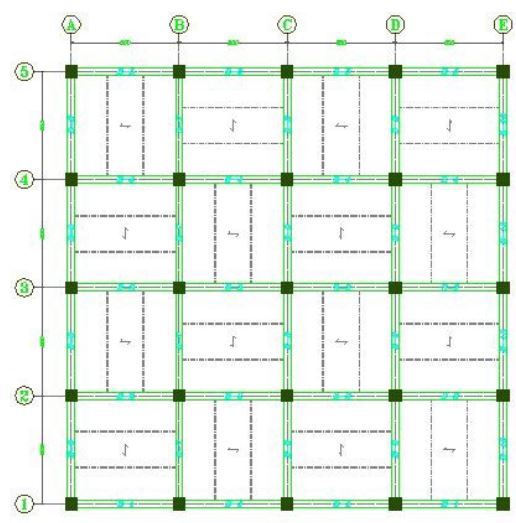
Increasing volume of constructions and necessity of having economic structures lead to the production of high-strength reinforcement (HSR). HSRs have many benefits; however, because of limitation in producing ductile HSR and the effect of HSR in the reduction of overall ductility of reinforced concrete structures, its application has been limited in seismic prone areas especially in special Reinforced concrete(RC) moment-resisting frames. In this research, the effect of HSR application on drifts, displacements, and quantity of consumed steel are studied by the linear static analysis, and also the base shear and proportionate displacements to them are studied by the nonlinear static analysis (Pushover) with ETABS software (for nine models with different numbers of stories and grades of steel). Then, the tensile strains of beams’ ends which can be a representation of cracking phenomenon in concrete are acquired conducting nonlinear dynamic analysis with Opensees. Ultimately, it is shown that although HSRs have economic benefits, they increase displacements and drifts. To compensate this issue, it is necessary to increase the rigidity of members by increasing steel quantity or dimension of members. This is a serious challenge because it neutralizes steel consumption reduction. It is also shown that by substituting the reinforcement bars for higher grade ones: the level of tensile stress in concrete alongside with the tolerated displacement in order to enter the nonlinear stage in Pushover analysis increases. Moreover, the less the grades of steel, the fewer shears are tolerated by structures.
Over several decades the design of reinforced concrete structures was dominated by the application of steel reinforcement bars with yield strength (fy), equal to 280 MPa (40 ksi). In the late 1960s, the typical yield strength increased to fy=420 MPa (60 ksi). A design with steel having higher yield strength values has been permitted; the 1971 edition of ACI 318 (1971), for instance, limited the yield strength to fy ≤ 560 MPa (80 ksi), Lepage et al. 2008 [1]. As another example, ACI 318-08 permits the application of reinforcement bar having a design yield strength, defined as the stress corresponding to a strain of 0.0035, not exceeding 560 MPa (80 ksi) [2]. With more development in technology, the capability of producing higher grade reinforcements was reached and the temptation of constructing with less amount of materials such as steel and concrete made researchers focus on the application of stronger materials.Using high-strength reinforcements have some advantages: decreasing the number of laborers and material expenses, expenses of peripheral issues such as cranes or transportation and overhead expenses, (Kheyroddin and Arshadi [3, 4]), decreasing construction time duration and making the process of construction easier. The expenses of reinforcements are nearly 30 percent of the structural expenses, and reduction of their amount can make constructions more economical. However, application of them has also some disadvantages such as: 1) The crack width under service and design loads, because the elasticity module of high strength reinforcements are similar to the ordinary ones and their levels of tensions are higher than theirs, then their crack width under service and design loads will be larger, 2) The brittle failure threat in which concrete will be crashed before steel yielding, for this reason, the codes limit the yielding stress of steels, 3) The ambiguous effect of them on seismic behavior of the structures limits their application in areas with a high hazard of seismicity [5]. These effects are the subject of many pieces of analytical and experimental research in these days.
This study aims to overview the effect of using high-strength reinforcement bars on the drifts, displacements, base shears and the number of consumed reinforcements by linear and non-linear static analysis with the ETABS software (Wilson & Habibullah). The non-linear behavior of elements is considered by assigning displacement and force control hinges on them. Then the strains of both ends of the beams of structures are acquired with the non-linear dynamic analysis with Opensees. In this case, the non-linear behavior is applied by using a distributed plasticity. The results showed that, although the number of reinforcements decreases by using HSR, the drifts and displacements increase. This is a paradoxical challenge that needed to be compensated by adding more steel. This means neutralizing the benefit of reducing steel consumption. It is also shown that by substituting reinforcement bars for higher grade ones: the level of tensile stress in concrete alongside with the tolerated displacement in order to enter the non-linear stage in pushover, increases. Moreover, the less the grade of steel, the fewer shears are tolerated by structures.

Semnan University of Medical Sciences and Health Services
DOI: 10.22060/ceej.2017.12406.5207