

Publication
An investigation into the behavior of special moment frames with high-strength reinforcement subjected to cyclic loading
Doi: 10.1016/j.jobe.2019.100905
Hamed Arshadi
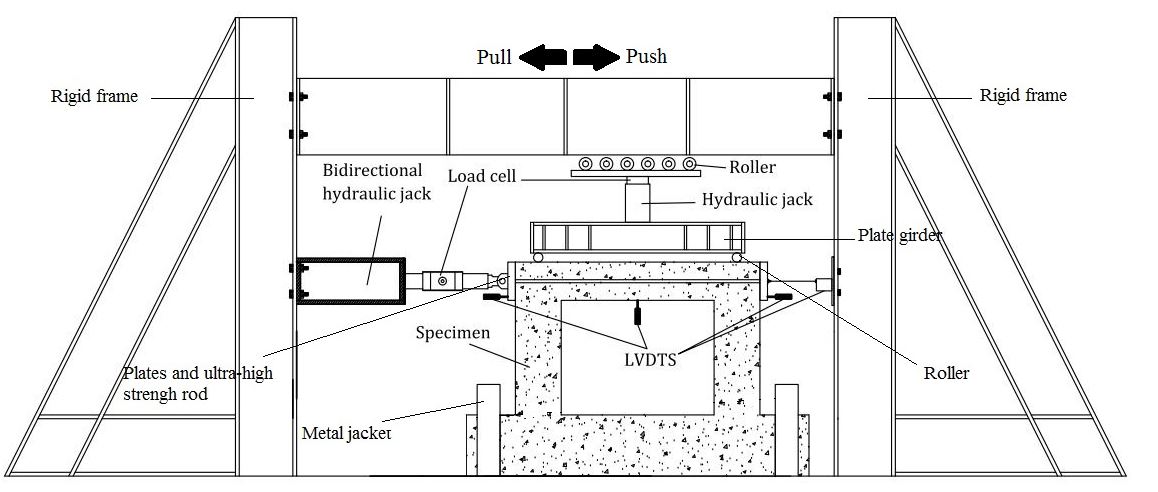
High-strength reinforcement (HSR) application has many advantages, such as decreasing expenditures and construction time, and improving construction quality. However, its application has been limited in special moment frames by several building codes. This limitation is due to some challenges related to a possible reduction in overall ductility and serviceability of reinforced concrete (RC) structures. In this research, the effects of HSR application on the stiffness, drifts, energy dissipation, ductility, cracking patterns, and damage indices of four special moment frames are experimentally investigated. These special moment frames have the same geometry and equivalent amounts of reinforcement (with yield strengths of 500 and 580 MPa). The frames are tested under cyclic loading. Results indicate that all the frames achieved drift ratios exceeding 4% before they showed a critical decline in their lateral strength. Moreover, replacing the grade 500 MPa reinforcement with reduced amounts of the grade 580 MPa reinforcement led to a comparable deformation capacity. Experimental observations also showed that by using higher-strength reinforcement, the cracking patterns changed: the higher the yield strength, the wider and deeper the cracks.
Over the past decades, designing reinforced-concrete (RC) structures has been dominated by the application of steel reinforcement with the yield strength, fy, equal to 280 MPa. The definition of high-strength reinforcement (HSR) is relative, but nowadays a reinforcement bar with the yield strength of 500 MPa is considered to be HSR. There are several types of HSRs available in different countries. For example, in the United States, the MMFX (Micro-composite, multi-structural, fonnable) steel, which is a high-strength and corrosion-resistant steel, has been subjected to several experimental studies. In Japan, reinforcement bars with a yield strength of 700 MPa are allowed to be used in even earthquake-resistant buildings. In New Zealand and Australia, AS/NZS Grade 500E is also used as a reinforcement bar for earthquake-resistant members. The E (at the end of the grade designation) indicates that the steel bar is intended to resist earthquake influences. In Iran, A4 reinforcement with a yield strength of 580 MPa is produced by the Thermex method (a thermo-mechanical treatment). HSR application has several advantages, such as decreasing labor and material costs, expenses of peripheral issues (such as crane, transportation and overhead expenses), and construction time. On the other hand, there are important possible obstacles to the application of HSR, such as increasing crack widths under service loads (the tension level of HSR is higher than the ordinary reinforcement, because the elasticity module of HSRs is similar to that of ordinary bars), the brittle failure phenomenon (in which concrete will be crushed before steel yielding), and vague effects of HSR on the seismic behavior of RC structures.HSR application is highly restricted in the special moment frames by building codes because of the above-mentioned possible challenges. Some of these possible challenges are not completely known and may be prevented by either using new designing approaches or applying new types of HSR (made by the Thermex method) which have appropriate ductility. Special moment frames consist of beams, columns, and joints, which can be studied singly or along with each other. Although the latter case gives much closer results to those in reality (because of considering the interaction of all these parts together), most researchers have been focusing on the seismic behavior of the separate parts (only the columns, the beams or the joints). Then, there are not enough experimental investigations about HSR effects on the seismic behavior of the special moment frames. Moreover, most the researchers have focused on the influence of HSR as longitudinal reinforcement and have not studied them as a stirrup. Thus, the NEHRP report strongly advises researchers to study the effects of HSR as both the longitudinal and transverse reinforcement bars on the seismic behavior of the special moment frames.
In this study (with regard to this mentioned research gap), the effects of HSR on the drifts, cracking pattern, ductility, secant stiffness, energy dissipation, sequence of the plastic hinge formation and damage indices are experimentally investigated in four special moment frames. These frames have the same geometric characteristics and equivalent amounts of reinforcement, but with different yield strengths (grades 500 and 580 MPa). These steel bars are constructed with a rather modern technological method called the Thermex method. The concrete strength is also 30 MPa for all the specimens. The frames are designed based on the special seismic provisions of ACI 318-14. They are tested under cyclic loading and their responses compared with each other. Experimental results indicated that a favorable distribution pattern of plastic hinges on the beams and columns were reached by HSR application. These results also demonstrated that all the specimens reached drift ratios exceeding 4% before they displayed a critical decline in lateral strength. It must be reminded that drift capacities in excess of 4% are enough in seismic designs. The frames with higher-strength reinforcement had a significant drift capacity. The experimental results showed that the yield displacements of the specimens increased and their ultimate displacement decreased by using HSR. The results also indicated that energy dissipation (areas of load-displacement loops) and ductility decreased, too. However, the effects of HSR as longitudinal or transverse reinforcement on them were not as the same. Generally, it was observed that applying HSR as transverse reinforcement had better effects in comparison to its application as longitudinal reinforcement (with regard to the energy absorption and ductility). Regarding the stiffness degradations, the results also showed that using HSR expedited the stiffness degradation process of the specimens to some extent. However, HSR influences on stiffness degradation as stirrup or longitudinal reinforcement were different. The specimen with HSR as only longitudinal bars had the most intense stiffness degradation among the specimens. As for the damage indices, using HSR as stirrups led to increasing the damage indices unlike to its application as longitudinal reinforcement. Finally, the results demonstrated that the depth and width of the cracks increased by replacing the reinforcement with a higher-grade one.

Semnan University of Medical Sciences and Health Services
Doi: 10.1016/j.jobe.2019.100905